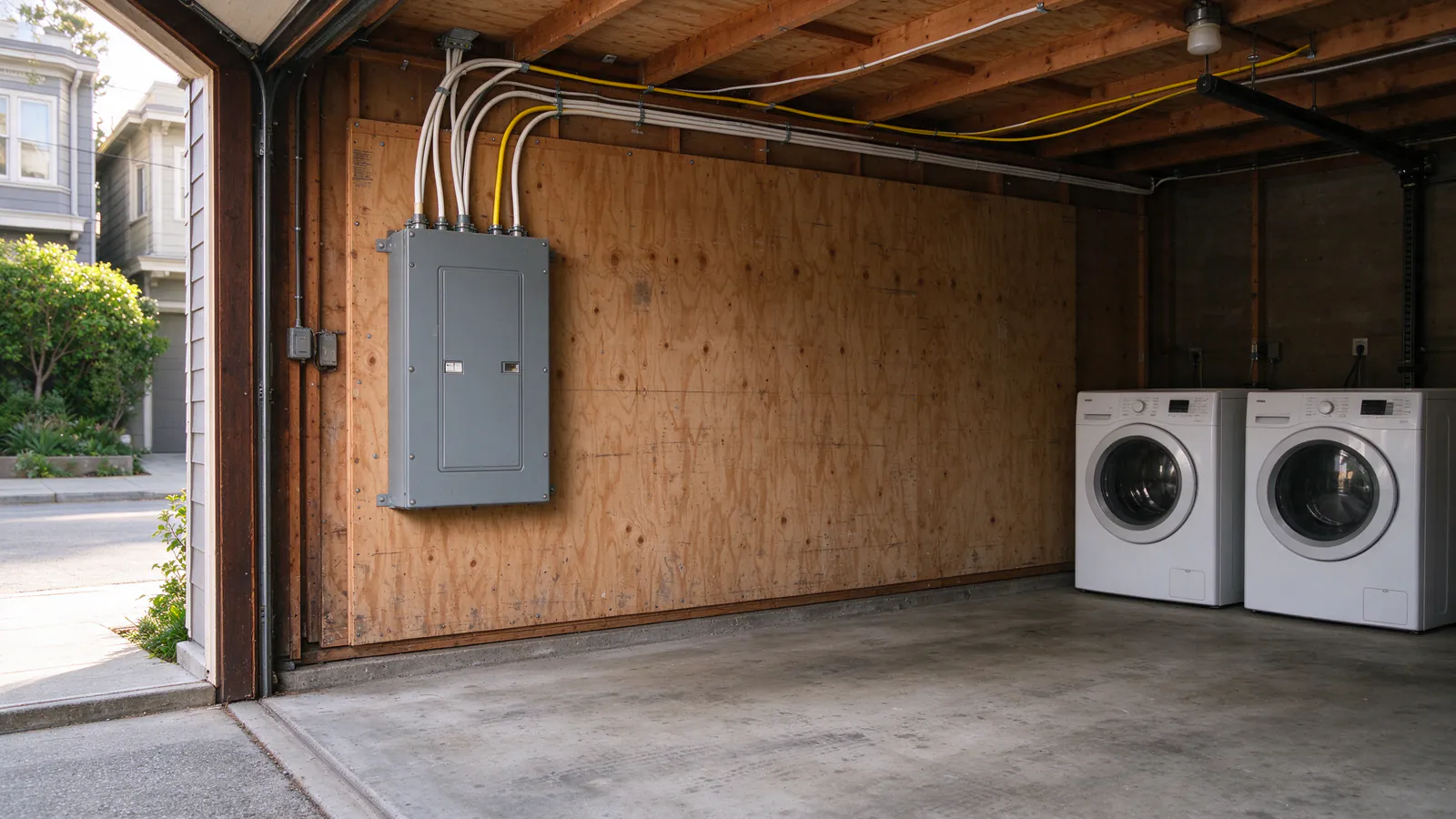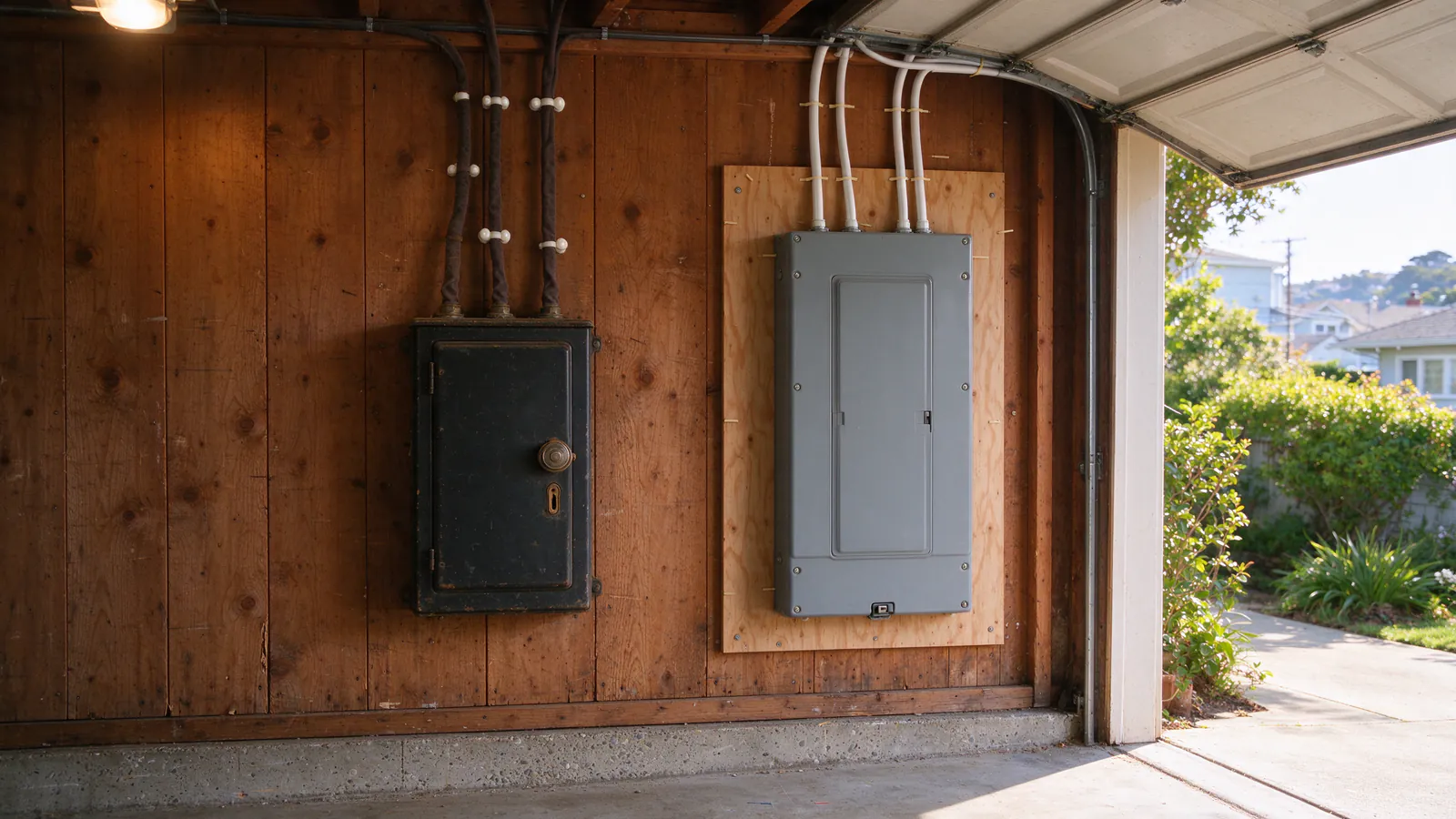
No. A new panel replaces the box where circuits start, not the circuits themselves. Every knob and tube run that was connected to the old fuse box is reconnected to a breaker in the new panel and keeps working exactly as before, with the same ungrounded conductors, the same aging insulation and the same splices. Removing knob and tube means replacing the branch circuits.
Fog City SF Knob and Tube manages both kinds of work in San Francisco and the East Bay, panel upgrades and knob and tube rewiring, with the electrical work carried out by licensed and insured electrical contractors. This guide explains what each one changes, how they depend on each other, and how to decide whether you need one, the other or both.
Two parts of one system
The electrical system in a house has three layers. The service brings power from PG&E’s lines to the meter. The panel, or panelboard, divides that power into branch circuits and protects each one with a fuse or breaker. The branch circuits carry power from the panel to the lights, outlets and appliances.
Knob and tube is a method of branch-circuit wiring. It lives entirely in the third layer. That is why the panel and the wiring are separate decisions: the panel can be modern while every branch circuit is original, and the branch circuits can be new while an old panel still feeds them. The knob and tube wiring guide explains how the system’s original branch circuits were laid out.
What a modern panel does
A modern panel replaces screw-in fuses with circuit breakers, which can be reset instead of replaced. It usually has more spaces, so new circuits have somewhere to land. It accepts arc-fault and ground-fault breakers, which a fuse box cannot. And if the service is upgraded with it, it can carry more total load, which matters for induction ranges, heat pumps and car chargers.
What it does not do
It does not add a ground wire to circuits that have none, renew rubber insulation, remove splices or take wiring out of attic insulation. The three-prong outlets guide and the AFCI and GFCI guide explain what grounding and protective devices can and cannot add to old circuits.
Fuses are not the same thing as knob and tube
Owners often treat “fuse box” and “knob and tube” as one problem, because they tend to appear together. They are related but not the same. Fuse boxes also fed the ungrounded cable wiring that followed knob and tube, and plenty of San Francisco houses replaced their fuse box with a breaker panel decades ago while the branch circuits stayed original. A breaker panel is not evidence that the knob and tube is gone, and a fuse box is not proof that it is still there.
San Francisco’s permit records show how often the two meet. Of 2,023 electrical permits filed since 2016 whose descriptions name knob and tube, 223 mention a service upgrade, main panel or meter, 229 mention 200 amps, 72 mention 100 amps and 564 mention a subpanel. Some insurers ask for both pieces of work, as the insurance guide explains: one permit description reads that “the owners insurance company is requiring the owner to replace the knob & tube wiring and replace the federal pacific main breaker.”
The risks of reconnecting old circuits
When a panel is replaced and the knob and tube stays, the old circuits move to new breakers. That step can fix a problem or carry one forward.
Overfusing. When an old circuit kept blowing its fuse, a common response was to fit a larger fuse. If the new panel simply matches what was in the fuse box, the oversized protection moves with it. A panel change is the moment to size each breaker to the conductor it protects, which can mean a circuit that used to run a heater now trips, because it always should have.
Protective devices on old circuits. Arc-fault and ground-fault breakers detect patterns that knob and tube can produce for wiring reasons rather than faults, such as a neutral shared between circuits. They can trip repeatedly on old circuits, which is a reason to trace the circuit rather than to fit an ordinary breaker instead.
Local rules on altering old equipment. In the East Bay, Oakland treats adding a circuit or wiring to service equipment in a “dog-house” enclosure, or to a fuse box in a clothes closet, as an alteration, and allows that equipment to be maintained and repaired but not altered. Alameda’s Building Official notes that circuits can be added to an existing non-compliant panel in a closet, but that swapping out the panel requires code compliance. In San Francisco, the Electrical Code says existing wiring need not be altered if it was legal when installed and has been maintained. Rules for a specific address are confirmed during the permit.
Panel compatibility and capacity
Whether a panel can carry a rewiring plan comes down to three checks.
- Spaces. A rewire usually splits a few old circuits into many new ones: dedicated kitchen, bathroom and laundry circuits, plus general circuits sized for how rooms are used. The panel needs a space for each, or a subpanel.
- Condition and listing. A panel that is damaged, overheated, recalled or not able to accept the breakers the new circuits need is replaced rather than reused.
- Capacity. A load calculation adds up what the house will run after the rewire. If the total exceeds what the service can supply, the service is upgraded, for example from 100 to 200 amps, which involves PG&E.
The knob and tube amp rating guide covers what old circuits can carry, and the electrical panel upgrade service covers panels and services.
Panel, wiring or both?
A walk-through tests every circuit and checks the panel and service, so the plan says which of the two your house needs.
Comparing the choices
| Panel or service upgrade only | Rewiring only | Both together | |
|---|---|---|---|
| Knob and tube left live | All of it | None on replaced circuits | None on replaced circuits |
| Grounded outlets | No change | On every new circuit | On every new circuit |
| Overfusing | Fixed if breakers are sized to old conductors | Fixed on new circuits | Fixed throughout |
| AFCI and GFCI breakers | Possible, may trip on old circuits | Through the existing panel if it accepts them | Planned into the new panel |
| Room for new loads | More capacity and spaces | Limited by the existing panel | Sized for the rewiring plan |
| Utility involvement | PG&E if the service changes | None | PG&E if the service changes |
| Typical cost | $3,000 to $10,000, a typical San Francisco range for 100 A to 200 A overhead | $20,000 to $50,000 or more, a typical San Francisco range for a single-family whole-house scope | The two ranges combined |
| DBI permit | Category 3 service equipment of 225 A or less is $450 | $740 for more than 40 outlets and devices | Up to 40 devices including a 200 A service is $580; larger scopes are priced by category |
Underground service with trenching can run past $10,000. The cost guide explains what moves each range, and the whole-house rewiring and partial replacement services cover the branch-circuit side.
Which order makes sense
When both are needed, planning them as one project is usually best. The rewiring plan fixes the number of circuits the panel must hold, the load calculation fixes the service size, and one permit sequence covers both. The utility side has its own process: residential panel changes up to 320 amps go through PG&E’s Express Connect, and PG&E’s tariffs give an allowance of $3,255 per dwelling unit toward service extensions; whether it offsets an upgrade of an existing service is a question for PG&E on each job. Homeowners report that the utility steps can take months, so they are best started early.
When only one can happen now, a panel first is reasonable if the panel is failing, an insurer has named it, or new loads cannot wait, provided breakers are sized to the old conductors and the record says plainly that the knob and tube remains. Rewiring first is reasonable when the panel has room and capacity for the new circuits. What causes trouble later is a panel upgrade described, in a listing or to an insurer, as if it had removed the knob and tube.
How to tell which one you need
Signs point to the panel when breakers or fuses are full, damaged or warm, when the panel is a model an insurer has named, or when a planned appliance needs more capacity than the service has. Signs point to the wiring when circuits still run on knob and tube, outlets are ungrounded, or wiring is buried in insulation or spliced into later cable, the case the mixed wiring guide covers. Often both lists apply. The signs your house needs rewiring guide pulls those decision points together, and a knob and tube inspection shows which circuits are still live.
To sort out your own house, call (628) 296-7628 or request an estimate with the age of the house, what the panel looks like and what you plan to add.