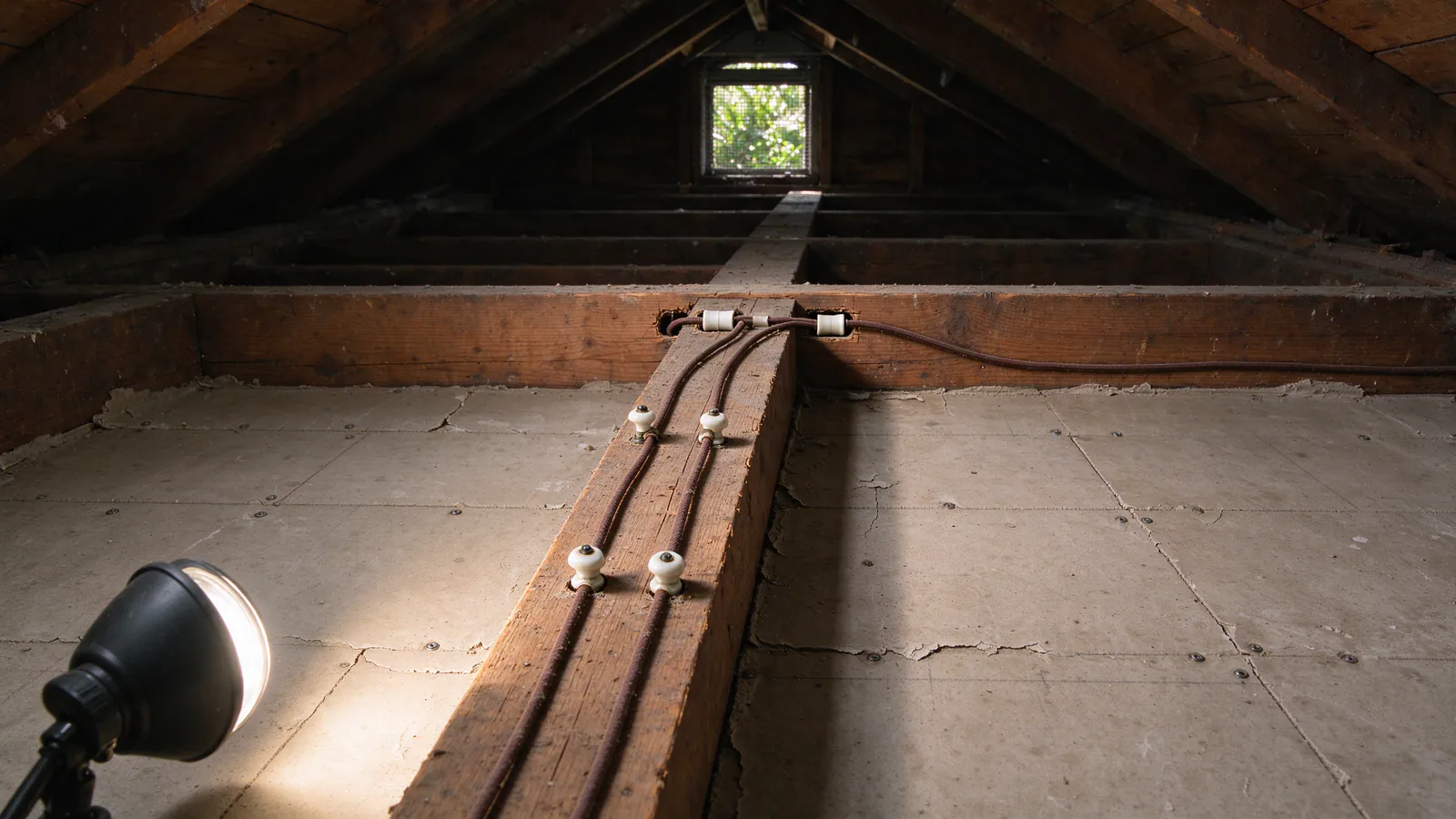
Knob and tube wiring is the original electrical system in most older San Francisco houses: two separate insulated wires, a hot and a neutral, run through walls, floors and attics on porcelain knobs and through porcelain tubes, with no ground wire. It was the standard way to wire a home before about 1940, and much of it is still in service.
That combination of age and survival is the work Fog City SF Knob and Tube does: it replaces knob and tube wiring across San Francisco and the East Bay, managing each job while licensed and insured electrical contractors carry out the electrical work. This guide explains how the system works, what it did well, where it falls short, how to tell whether a house has it, and what California and San Francisco rules, insurers and incentive programs say about it now. When you are ready to act on it, knob and tube replacement is the service that resolves it.
A short history, and why San Francisco has so much of it
Knob and tube was the dominant way to wire American homes from the early decades of residential electric service until about 1940. Houses built in the 1940s can also contain it, or contain the transitional cable wiring that followed it. What makes San Francisco unusual is how much of its housing dates from that window and is still standing.
The Census Bureau’s American Community Survey counts 187,447 of San Francisco’s 414,602 housing units, or 45.2%, as built in 1939 or earlier, and 53.6% before 1950. Statewide, only 8.9% of California’s housing predates 1940. Part of the reason is the 1906 earthquake and fire. SF Planning’s Inner Mission North context statement finds that most of the area’s buildings date from 1906 to 1930, after the fire, and notes that of the buildings erected citywide from 1906 to 1913, more than 24,000 remain. That rebuild happened squarely in the knob and tube era, and it produced the Victorian and Edwardian flats that still line the Mission, Haight-Ashbury and Alamo Square.
The west side came a little later. SF Planning’s Sunset District context statement dates most Sunset construction to 1925 through 1950, single-family houses over integrated garages on 25-foot lots, and notes that by the late 1930s large merchant builders were organizing specialized crews for framing, sheetrock, siding and roofing. A Sunset or Parkside house from that period may have knob and tube, cable wiring or a mix, which is one reason house age alone never settles the question.
How knob and tube works
Knob and tube is a two-wire system. A hot conductor and a neutral conductor leave the fuse box as separate wires, each with its own rubber insulation and a cloth outer covering, and travel through the house several inches apart. There is no cable jacket holding them together and no third wire for grounding.
Open-air conductor routing
The defining feature is that the conductors run in open air. Along the length of a joist or stud, each wire is held on its own porcelain knob, nailed to the framing, so it never touches wood. Where a wire has to pass through a joist or stud, it goes through a porcelain tube set in a drilled hole. Running the hot and neutral on separate supports, spaced apart, kept them from rubbing on each other or on the framing, and let the heat from current in each wire escape into the surrounding air.
That reliance on air is the key to understanding the system’s limits. The original design assumed the wires would stay in open, ventilated cavities. Anything that removes the air, such as blown-in or batt insulation packed around the conductors, changes the conditions the wiring was built for. It is also why knob and tube is easiest to see and assess in attics, basements and garage ceilings, where the framing is still open.
Knobs, tubes, loom and splices
The porcelain parts are the most durable piece of the system and often look as good as the day they were installed. Where a wire left the open framing to reach a switch, outlet or fixture, it was usually slipped into loom, a flexible woven tubing that protected the conductor at the transition. Branches were made with splices: a tap wire twisted onto the run, then soldered and wrapped. Those splices sit in the open framing, not in a box, which was normal at the time and is one of the things a modern inspection looks at most closely.
Original branch circuits and fuses
A branch circuit is the wiring from the last fuse or breaker out to the lights and outlets it serves. Original knob and tube houses had few of them. A circuit might serve several rooms’ ceiling lights and a handful of wall outlets, because the loads it was designed for were mostly lamps and small appliances. Each circuit was protected by a fuse, usually a screw-in plug fuse in a small fuse box near where service entered the house.
Those original branch circuits are the part a replacement actually replaces. A new panel can be installed with every one of them still connected to it, which is why the panel upgrade vs rewiring guide treats them as two separate decisions. The original circuit layout is also why so many older houses have rooms with one outlet, extension cords along the baseboards, and fuses or breakers that trip when a heater and a hair dryer run at once. The knob and tube amp rating guide goes into what those circuits can carry.
What knob and tube did well
It is easy to talk about knob and tube only as a problem, but the design was sound for its time. Separating the conductors by several inches made a short between them unlikely, because a fault needed both wires to fail at the same point. Running them in open air kept them cool, so the conductors could carry their load without heat building up the way it can in a bundled cable. Porcelain does not burn, conduct or decay, and the knobs and tubes held the wires off the framing for decades.
That is why undisturbed knob and tube in open, dry framing can still be in serviceable condition. San Francisco Fire Department investigators told ABC7 News that the department “has not seen trends in knob and tube electrical wiring residential structure fires.” The concern today is less the original installation than what a century of use, alteration and new loads has done to it.
Where it falls short today
Knob and tube’s limits come from what it lacks and from how houses have changed around it.
There is no equipment grounding conductor. A ground gives fault current a path back to the panel so a breaker or fuse can open quickly, and it is what makes a three-prong outlet meaningful. Knob and tube circuits have only two wires, so their outlets are two-prong, and a three-prong outlet swapped onto one is not grounded unless it is protected or wired in one of the ways the code allows. The grounded outlets service covers the real fixes.
There are too few circuits for modern loads. Kitchens now run several high-wattage appliances at once, bathrooms have heaters and dryers, and electrification adds ranges, heat pumps and car chargers. On an original circuit layout, those loads land on wiring designed for lamps.
It does not tolerate being covered. The open-air design needs open air, and the California Electrical Code bars concealed knob and tube in insulated hollow spaces where the insulation envelops the conductors, except under a narrow certification process explained below.
It cannot easily be extended. Adding to a knob and tube circuit means splicing new wiring onto old conductors whose insulation may crack when moved. Some electricians will not extend it at all, and the City of Alameda’s Building Official states plainly that knob and tube “cannot be extended.”
And its rubber insulation ages. That is the failure mechanism behind most of the rest.
How to tell whether a house has it
The surest sign is the wiring itself: single wires on porcelain knobs along attic joists, basement framing or a garage ceiling, or porcelain tubes through the framing. Two-prong outlets, a fuse box and ceiling fixtures with no box behind them are clues, but none of them is proof either way. The identification guide walks through what to look for, and the cloth wiring comparison explains how to tell knob and tube from the cable wiring that followed it.
Two common assumptions mislead owners. A three-prong outlet does not prove a circuit is grounded or modern; it may sit on a knob and tube run. And visible modern cable in a basement does not mean the knob and tube is gone: remodels often replaced the parts that were easy to reach and connected the new cable to old runs that stayed active inside walls and ceilings.
Do not handle suspect wiring to find out. Old insulation can crack when moved, and some runs that look abandoned are still live. What matters most is not whether knob and tube is present but whether it is still energized, which only testing can show; the active vs abandoned guide explains the difference, and a knob and tube inspection maps it circuit by circuit.
How knob and tube fails
Knob and tube rarely fails all at once or in the same way twice. These are the mechanisms behind most problems, and the knob and tube danger guide covers each in more depth.
Insulation breakdown. The rubber insulation under the cloth covering hardens and cracks with age, heat and handling. Where it cracks near a knob or at a bend, the bare conductor is exposed. In open air that may sit harmlessly for years; near a nail, a pipe, a rodent nest or the other conductor, it does not.
Splices and later connections. Original soldered splices were made in the open and can loosen or lose their wrapping. Later additions are the bigger concern: new cable tied into an old run without a box, a connection buried in a wall or ceiling, or a mix of wire sizes on one circuit. A loose or improper connection can heat and arc, and it is usually hidden.
Overfusing. When a circuit kept blowing its fuse, a common response was to install a larger fuse. That stops the nuisance but lets more current through wiring that was never meant to carry it, so the protection no longer protects the wire. A modern panel can carry the same mistake forward if old circuits are connected to oversized breakers.
Insulation over the wiring. Attic and wall insulation added for energy savings can envelop conductors that were designed to shed heat into air, and it hides their condition from anyone looking.
Overload. Heaters, kitchen appliances and air conditioners on original circuits can run them hot for hours.
Alterations by many hands. A century of owners, remodels and repairs means two houses of the same age can be wired very differently, which is why no rule of thumb replaces testing.
Signs to act on now
- A warm or discolored outlet, switch or cover plate
- A burning or hot-plastic smell near wiring, fixtures or the panel
- Lights that dim or flicker when something else turns on, together with heat or smell
- Fuses that blow repeatedly, or evidence that someone has installed larger fuses
- Wiring buried in insulation or damaged by rodents in the attic
Stop using an affected circuit and have it checked before relying on it again.
Findings that can wait for a plan
- Knob and tube present but undisturbed in open framing
- Two-prong outlets with no other symptoms
- An inspection report or insurer question with a deadline that leaves time to test first
These still deserve a plan, but not an emergency.
The rules in California and San Francisco
Is knob and tube legal?
Existing knob and tube is not automatically illegal. The California Electrical Code still contains Article 394 covering concealed knob and tube wiring. San Francisco’s Ordinance 228-25 adopted the 2025 California Electrical Code with local amendments, operative January 1, 2026, and those amendments make no change to Article 394. The San Francisco Electrical Code says existing wiring need not be altered if it was legal when installed and has been maintained, and that unused conductors must be either removed or identified and terminated in an approved manner. The California legality guide covers the details, including the line between keeping existing wiring and extending it.
Insulation and knob and tube
Article 394.12 bars concealed knob and tube in hollow spaces of walls, ceilings and attics where loose, rolled or foamed-in-place insulation envelops the conductors. California adds an exception that allows insulation only if a California-licensed electrical contractor surveys the wiring and certifies it is in good condition, with no deterioration, improper overcurrent protection or improper connections or splices; the certification is filed with the building department and a copy given to the owner; caution notices in English and Spanish are posted at accessible insulated areas; and the insulation is noncombustible and not electrically conductive. Berkeley turns this into a standard form; no equivalent San Francisco DBI form was found, so the code’s own steps apply. The attic insulation service handles the survey or the rewiring that clears the way.
Permits and who may do the work
Replacing knob and tube needs a San Francisco DBI electrical permit before new wiring goes in. Contractors applying must hold one of the license classifications DBI lists, with the C-10 electrical license covering any electrical work, and under California Labor Code 108 the people doing electrical work for a C-10 contractor must hold state electrician certification. An owner can take out a homeowner electrical permit only for a stand-alone single-family home that is their primary residence, must do the work personally, and can still be told at the Permit Center to hire a licensed contractor; LLCs are not eligible. The work gets a pre-cover inspection before walls close and a final inspection before DBI issues a Certificate to Connect Current, the Green Tag. The San Francisco electrical permit guide walks through the process, and can I replace knob and tube myself covers the homeowner route honestly.
Home sales
California Civil Code 1102.6i, on or after January 1, 2026, requires sellers or their agents to give buyers a statement that it may be advisable to have a qualified professional inspect the electrical system, and that substandard, recalled or faulty wiring may cause a fire risk and may make property insurance difficult to obtain. It does not require replacement. The guides for buying and selling a house with knob and tube cover how that plays out in escrow.
Insurance and incentives
Insurance is what most often turns knob and tube from a note in a report into a project. A Bay Area broker told ABC7 News that if knob and tube goes on an application, “we are going to get declined,” and the San Francisco Chronicle has reported carriers tightening rules on older homes with outdated wiring. Thirty San Francisco electrical permits that name knob and tube, filed since 2016, cite an insurer in their descriptions. Homeowners report a wide range of outcomes, from no trouble at all to conditions requiring replacement within a short period. No carrier’s underwriting rule is public, so no contractor can promise how an insurer will decide.
The California Department of Insurance’s guide explains that after a policy’s first 60 days an insurer may cancel only for reasons set by law, and that a non-renewal needs written notice at least 75 days before expiration, stating the reason. The California FAIR Plan describes itself as the insurer of last resort when no other option is reasonably available. An electrical inspection for insurance gives an underwriter a written account of what is live and what is not, and the California insurance guide covers the options.
On incentives, BayREN’s EASE Home program reimburses up to $2,000 to fix active knob and tube, and BayREN’s announcement also listed $300 toward a licensed electrician’s certification that knob and tube is inactive (confirm that line with BayREN, since the program page does not show it), for income-qualified PG&E customers in homes of four or fewer units built before 2010, as part of an EASE Home weatherization project. Fog City SF Knob and Tube helps with the rebate paperwork, and the electrical contractors who do the work supply the electrician’s invoice and the inactivity certification the program asks for; BayREN decides eligibility and the amount. The BayREN rebate guide has the conditions, and the cost guide lists what else does and does not pay toward the work.
What an assessment covers
A useful assessment answers one question first: which circuits are still live on knob and tube. Everything else follows from that. A typical sequence:
- History. The age of the house, known remodels, any panel or service changes, and where knob and tube has already been seen.
- Circuit mapping. Each circuit is identified at the panel or fuse box and traced to what it serves, separating active knob and tube from abandoned runs and from later wiring connected to it.
- Accessible spaces. Attic, basement, crawlspace and garage framing are examined without disturbing the wiring, looking for insulation contact, damaged insulation, splices and later connections.
- Protection and grounding. Fuse or breaker sizes are compared with the wiring they protect, and devices are checked for grounding claims they cannot back up.
- Capacity. The panel and service are checked for condition, space and capacity for new circuits.
- Access planning. Plaster, drywall, ceilings, trim and floors are noted to work out where cable could travel if replacement follows.
What an assessment cannot do is see inside every closed wall. It should say plainly which conclusions rest on testing and which on what was visible. The risk assessment tool helps sort what you already know before a visit.
Scope options
Knob and tube does not have one fix. The right scope depends on what is live, its condition, what the house needs, and what an insurer, buyer or lender is asking for.
| Option | What it means | When it fits |
|---|---|---|
| Leave in place and monitor | Keep undisturbed, maintained circuits in service | Few live circuits in good condition, no insulation over them, and no insurer or sale pressing |
| Targeted repair | Fix one damaged run, splice or device | A single defect on a system that is otherwise sound or mostly abandoned |
| Partial replacement | Replace the circuits still live on knob and tube | An earlier remodel replaced most of the house |
| Whole-house rewiring | Replace every old branch circuit and add circuits | Much of the house is original or mixed, or walls are already open |
| Disconnect and abandon | De-energize runs and identify and terminate them in place | Runs are no longer needed and are hard to reach |
| Removal | Take out dead runs where they can be reached | Attic and basement runs that would confuse a future buyer or inspector |
A partial job should end with a written record of exactly what knob and tube remains, because the surprise that costs most later is a circuit everyone assumed was gone. The repair or replace guide goes into when a repair is reasonable.
How replacement works
Replacement means running new branch circuits along new routes and retiring the old ones; it is not a matter of pulling new wire through the old knobs. The usual sequence:
- Plan from the circuit map. The mapping becomes a rewiring plan: which circuits are replaced, which new ones are added, where each will run, and whether the panel can carry them.
- Permit. A DBI electrical permit is filed for each dwelling unit in scope.
- Route the new cable. Basement, garage and attic paths are used first. New cable, usually nonmetallic sheathed cable with a ground wire, or individual conductors in conduit where the code or the location calls for it, is fished through wall cavities with small openings at boxes and the tops and bottoms of cavities. In plaster houses, the plaster-wall rewiring methods keep those openings small.
- Boxes and devices. New boxes, receptacles and switches are installed where old ones cannot be reused, with arc-fault protection where CEC 210.12 requires it, ground-fault protection in the locations CEC 210.8 lists, and tamper-resistant receptacles under CEC 406.12.
- Inspect, then close. The pre-cover inspection happens before anything is closed up; then openings are closed and the final inspection and Green Tag follow.
- Retire the old wiring. Old runs are disconnected at both ends and removed where reachable, or identified and terminated, and the panel directory is updated.
- Patch. Openings are patched, and the patching is shown as its own line in the quote.
DBI presumes buildings built before 1979 contain lead paint unless a certified inspector shows otherwise, so openings in painted plaster follow lead-safe practice; the lead and asbestos guide explains what that adds. The replacement process guide covers each step in detail, how long it takes depends mostly on access and the number of circuits, and living at home during rewiring covers occupied houses.
Not sure what is still live in your house?
A walk-through tests each circuit and separates active knob and tube from abandoned runs before anyone talks about scope.
Living with knob and tube until it is replaced
Some owners keep knob and tube in service for a while, whether waiting for a remodel, saving for the work or deciding on scope. A few habits keep that period sensible. None of them involve working on the wiring yourself.
- Keep loads modest on old circuits. Run heaters, kitchen appliances and air conditioners from circuits you know are modern, not from two-prong outlets.
- Do not replace a blown fuse with a larger one, and do not let anyone else do it. Repeated blowing means the circuit is overloaded or faulty.
- Avoid daisy-chained extension cords and multi-outlet adapters on old outlets.
- Do not add insulation around knob and tube in the attic or walls without the certification California requires.
- Do not have anyone extend or tap an old circuit for a new outlet or fixture; new loads belong on new circuits.
- Treat warmth, discoloration, a burning smell or flicker with heat as a reason to stop using that circuit and have it checked.
- Keep any inspection report and circuit record; insurers and buyers will ask for them.
If you are weighing whether it is time, the signs your house needs rewiring guide pulls the decision points together, and the resources page has a buyer’s checklist. To talk through your own house, call (628) 296-7628, or request an estimate with the age of the house, the number of units and what prompted the question.