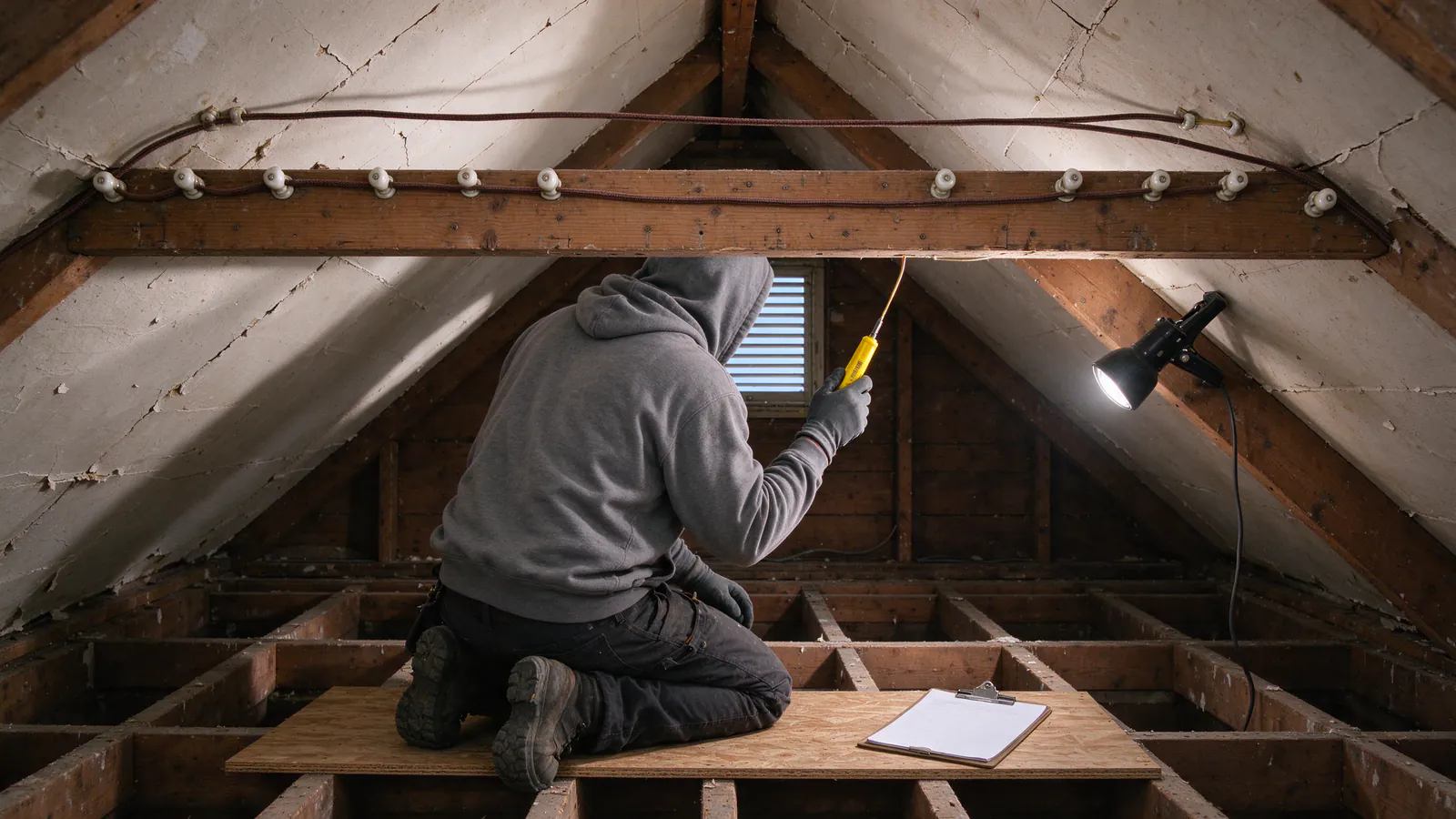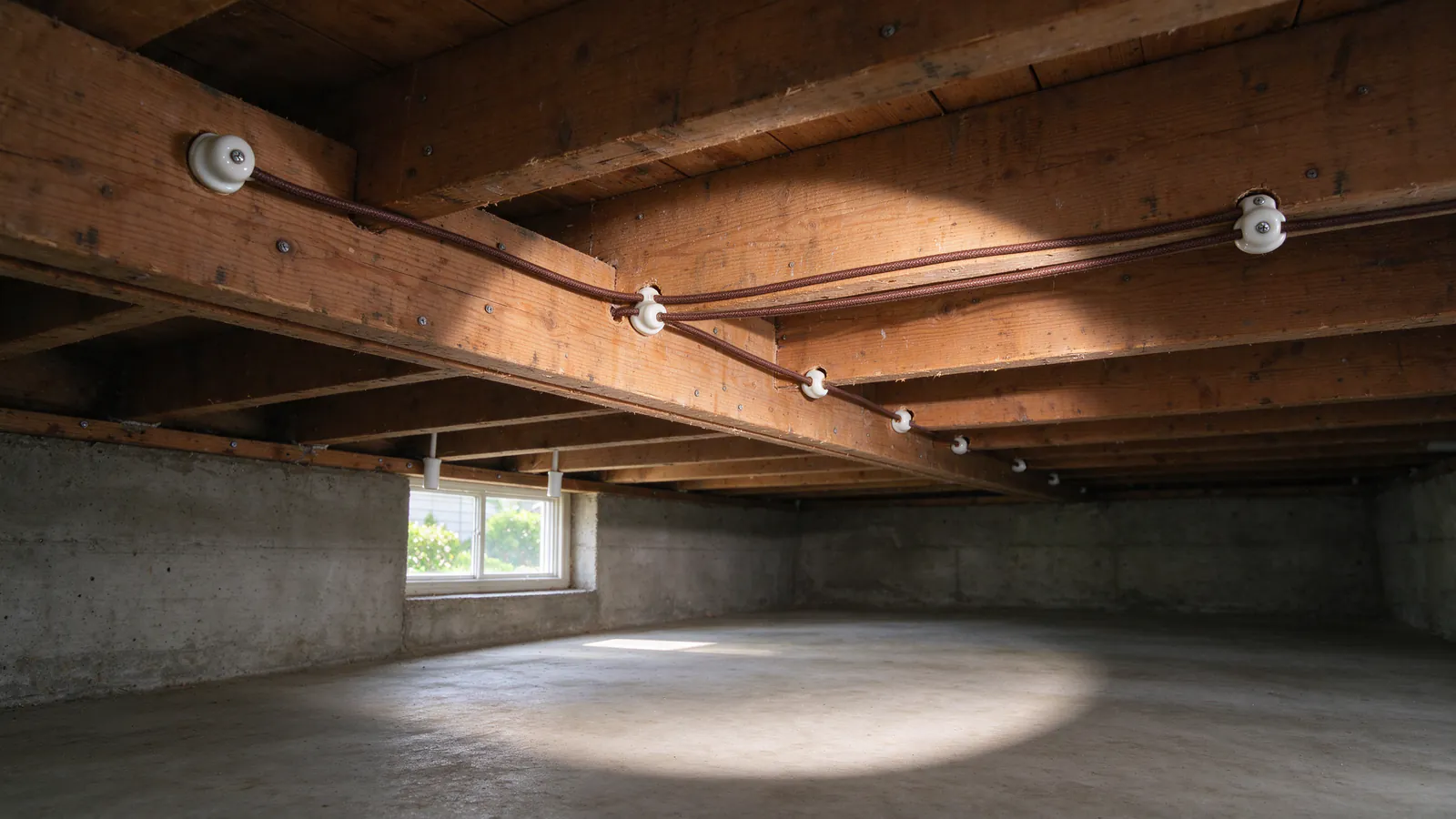
You identify knob and tube wiring by seeing it, not by guessing from outlets: single wires running separately on white or brown porcelain knobs along joists, and passing through porcelain tubes set in the framing. The places to look are open framing, such as the attic, the basement or garage ceiling and a crawlspace, using a flashlight and without touching anything.
That is the short version. Fog City SF Knob and Tube manages knob and tube inspection and replacement in San Francisco and the East Bay, with the electrical work carried out by licensed and insured electrical contractors, and this guide is meant to help you know what you are looking at before anyone visits. Seeing knob and tube answers whether it was installed. Whether it is still live is a separate question, and only testing answers it.
What the porcelain looks like
The knobs and tubes are the most durable part of the system and the easiest to recognize. A knob is a small porcelain spool, usually white or a glazed brown, fastened to a joist or stud with a nail through its center. The wire is wrapped around or tied to it so the conductor stands off the wood. Knobs appear in lines along the framing, one line for each wire, spaced a few feet apart.
A tube is a short porcelain sleeve set in a hole drilled through a joist or stud. Where a run crosses the framing instead of following it, each wire passes through its own tube. Looking along a basement ceiling, you may see a row of joists each with two tubes side by side, a few inches apart, and a wire through each.
Porcelain often looks as good as the day it was installed, which can mislead. Intact knobs say nothing about the condition of the insulation or splices between them, and they say nothing about whether the circuit is in use.
What the wires look like
Knob and tube runs a hot conductor and a neutral conductor as two separate wires. Each has rubber insulation under a woven cloth covering, which has usually darkened to black, brown or grey. They travel in parallel but apart, typically several inches, and there is no third wire anywhere on the run, because the system has no equipment grounding conductor.
Two other details help:
- Loom. Where a wire left open framing to reach a switch, outlet or ceiling fixture, it was often slipped into loom, a flexible woven tube that looks like a fabric sleeve over the wire.
- Open splices. Branches were made by twisting a tap wire around the run, soldering it and wrapping it in tape, out in the open framing with no junction box. A wrapped bump on a wire, with another wire leaving from it, is an original splice.
If you see two or three insulated conductors bundled together inside one outer jacket, that is cable, not knob and tube. Early cable often has a cloth-like outer jacket too, which is why the two get confused; the knob and tube vs cloth wiring guide explains the difference.
Where to look in a San Francisco house
The open-air design means knob and tube is visible wherever the framing is still exposed. Where that is depends on the building.
The attic. In houses with a walkable attic, the ceiling-light circuits for the top floor often run across the joists. Look from the hatch rather than climbing in; insulation can hide both the wiring and the gaps between joists. SF Planning’s Inner Mission North context statement notes that residential construction after 1906 favored flat roofs with a tar-and-gravel surface, so many Mission flats have little or no attic to look into.
The basement or garage ceiling. This is often the best view in San Francisco. SF Planning’s Sunset District context statement describes the typical Sunset and Parkside house of 1925 to 1950 as living space over an integrated ground-floor garage, and its Eureka Valley statement notes that early two-flat buildings usually sit on high basement stories, which let owners insert garages later. The floor joists over those spaces carry the circuits for the rooms above. Of 2,023 San Francisco electrical permits since 2016 whose descriptions name knob and tube, 187 mention a basement, crawlspace or garage, and 22 an attic.
A crawlspace. Look from the access opening only. Crawlspaces are tight and the wiring may be at head height.
Near the fuse box or panel. Wires leaving an old fuse box as separate conductors, rather than cables, are a strong sign the circuits they feed began as knob and tube.
Found porcelain in the attic or basement?
Porcelain shows how the house was first wired. Testing each circuit at the walk-through shows whether any of that wiring is still live.
Clues in the living space, and why none of them is proof
Most of the house hides its wiring, so owners look for indirect signs. Each of these is worth noting. None settles the question.
| Clue | What it suggests | Why it is not proof |
|---|---|---|
| Two-prong outlets | The circuit has no ground wire | Ungrounded cable from later decades is also two-wire |
| A three-prong outlet | Nothing on its own | It may sit on a knob and tube run with no ground behind it |
| A screw-in fuse box | An older electrical system | Fuses also served later cable wiring; breakers can feed knob and tube |
| Ceiling fixtures with no box behind them | Original fixture wiring | Later fixtures may have been mounted the same way |
| Push-button or old toggle switches | Original devices | Devices are often replaced while the wiring stays |
| Modern cable visible in the basement | A rewire happened somewhere | Remodels often replaced what was easy to reach and spliced onto old runs inside walls |
| The house was built before 1940 | Knob and tube was the standard then | Many houses were partly or fully rewired since |
The three-prong row deserves emphasis because it is the easiest one to misread. A three-prong receptacle can be installed on a two-wire circuit; the three-prong outlets guide explains when that is allowed and what it does not provide. The modern cable row is the other trap. A remodel that rewired the kitchen and the basement can leave bedroom ceiling lights on knob and tube for decades, connected through a splice nobody can see, which the mixed wiring guide explains.
Age and records
House age narrows the odds. The Census Bureau’s American Community Survey counts 45.2% of San Francisco’s housing units as built in 1939 or earlier, against 8.9% of California’s, and knob and tube was the dominant way to wire a home until about 1940. Houses from the 1940s can have it too, or have the transitional cable that followed it, which is why the west side is so often a mix.
Past permits can help. DBI’s electrical permit records are public, and a permit for a past rewire tells you work was done, though not always how complete it was. Of the 2,023 knob and tube permits filed since 2016, 121 describe de-energizing or abandoning old wiring rather than removing it, so even a permitted job can leave dead runs in place. A seller’s disclosure or an earlier inspection report may also mention it. If you are buying, the buying a house with knob and tube guide covers what to ask for during escrow.
Seeing it is not the same as knowing it is live
The question that matters for safety, insurance and scope is not whether knob and tube is present but which circuits still run on it. Porcelain in the attic may belong to a run that was disconnected at both ends in a remodel decades ago. A neat basement full of modern cable may still feed one old circuit upstairs. Looking cannot tell these apart.
Testing can. At a Fog City SF Knob and Tube walk-through, every circuit is tested and traced from the fuse box or panel to what it serves, separating active knob and tube from abandoned runs and from later wiring spliced onto either. The result is a written circuit record. The active vs abandoned guide explains why the distinction matters, and the knob and tube inspection is the service that does the testing. If an insurer has asked for an account of the wiring, the electrical inspection for insurance puts that in writing.
What to do with what you found
If you saw porcelain and single wires, note where, take photos from a safe position, and treat it as present until testing says otherwise. If you saw nothing but the house is old, that is not a clean result; it may only mean the framing is closed. Either way, the risk assessment tool helps you sort what you already know, and the knob and tube wiring guide explains how the system works and what the rules say about it.
Some findings should not wait: a warm or discolored outlet or switch, a burning smell near wiring, or wiring that looks damaged or chewed. Stop using that circuit and have it checked; the danger guide explains why those signs matter. For everything else, call (628) 296-7628 or request an estimate and send your photos with the age of the house.