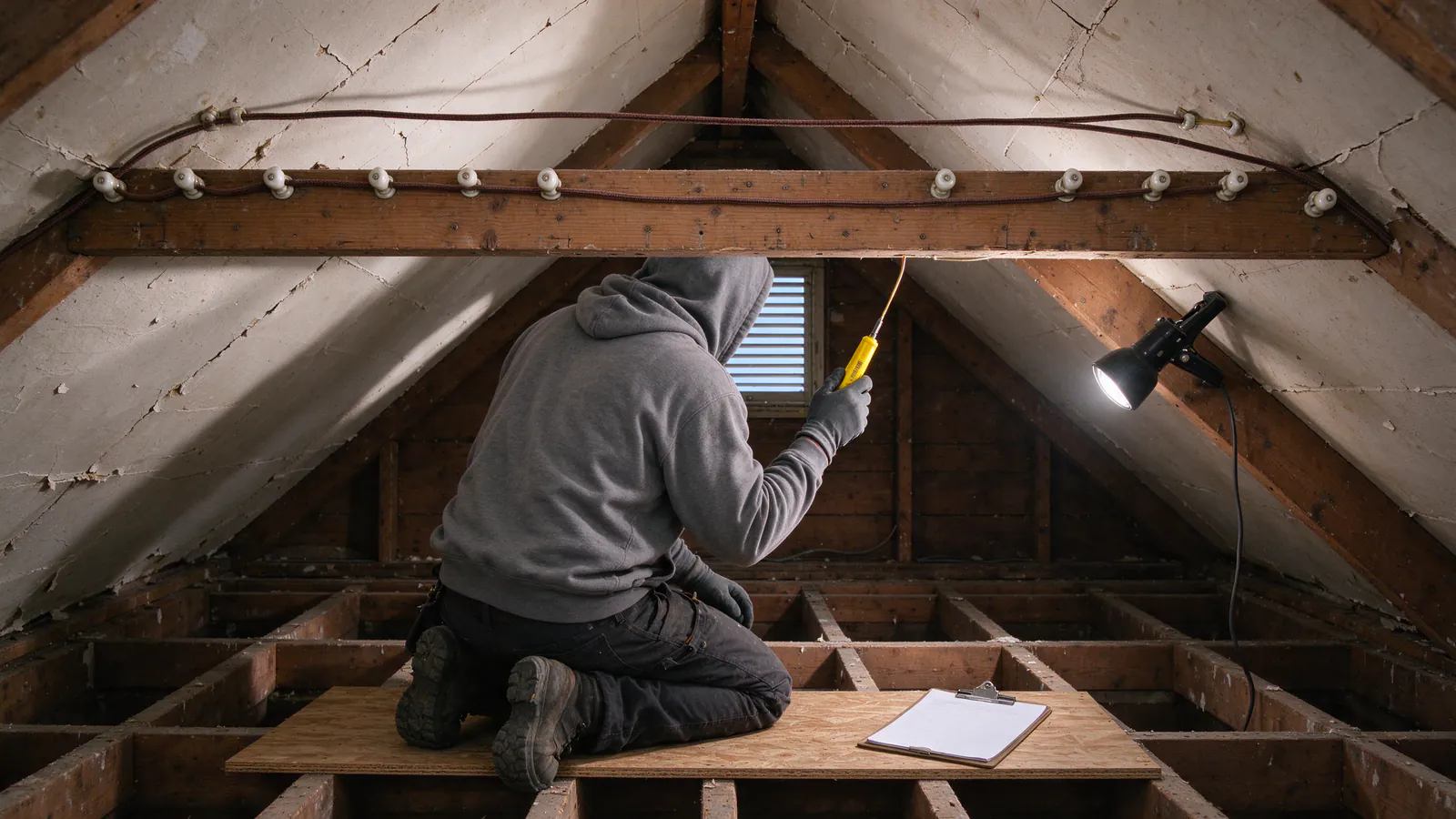
You can. Treat it as a project to price and an insurance question to settle before your contingencies expire. Three answers decide it: how much knob and tube is still live, whether a carrier will write a policy on the house as it stands, and what replacing the wiring would involve in that particular house. A general home inspection rarely answers all three.
Fog City SF Knob and Tube manages knob and tube inspection and replacement in San Francisco and the East Bay, with the testing and electrical work carried out by licensed and insured California C-10 electrical contractors. For a buyer, the useful step is a knob and tube inspection during the inspection period: every circuit tested at the walk-through, and a written record of what is live and what the work would take.
Why insurance is the real gate
A San Francisco agent told ABC7 News that knob and tube used not to be a deal breaker, “but now it’s become an insurance issue,” adding that without insurance the lender will not approve the mortgage unless the buyer pays for the California FAIR Plan. Another agent told the San Francisco Chronicle, “we’re making insurance often the contingency of the purchase.”
That shifts the order of your due diligence. Homeowners report carriers that ask on the application whether the house has knob and tube, carriers that send an inspector to photograph the panel, and carriers that offer a policy on condition that the wiring is replaced within a short period, around 30 to 60 days after closing in several accounts. Others report no trouble at all. Because no carrier’s rule is public and rules change, the only reliable answer for a given house is a quote, based on accurate answers, obtained before you remove your contingencies. The California insurance guide covers what carriers ask for and how the FAIR Plan works as a fallback.
Loan programs have their own property standards as well. Ask your lender at the start whether knob and tube must be addressed before funding, rather than at the end.
What a home inspection can and cannot tell you
A general home inspection is valuable, but it is visual and non-invasive. It can note porcelain knobs in the attic, two-prong outlets and an old fuse box. It usually cannot tell you which knob and tube runs are still energized, because that takes tracing circuits from the panel; it cannot see splices buried in walls or ceilings; and a plug-in tester can be fooled by a three-prong outlet wired with a false ground. Homeowners report finding knob and tube, bootleg grounds and a fake GFCI after a pre-purchase inspection had passed over them.
Two assumptions catch buyers. Visible modern cable in the basement does not mean the knob and tube is gone: remodels often replaced what was easy to reach and connected new cable to old runs inside walls. And three-prong outlets do not prove grounding, as the three-prong outlet guide explains. One San Francisco buyer reported finding an active knob and tube line that had been missed in a previous renovation.
An electrician’s assessment adds what the general inspection leaves out: each circuit mapped from the panel, live knob and tube separated from abandoned runs, fuse and breaker sizes checked against the wire, and attic and basement runs examined for insulation contact and splices. The identification guide covers what you can safely look for on a showing, and the active vs abandoned guide explains why the live or dead question comes first.
What to ask the seller
Since January 1, 2026, California Civil Code 1102.6(i) requires sellers or their agents to give buyers a statement advising an electrical inspection and warning that substandard, recalled or faulty wiring may make insurance difficult to obtain. That advisory is general; it does not tell you what is in this house. Ask for:
- Permit history. DBI’s electrical permit records are published on DataSF; a permit that names knob and tube, with a final inspection, tells you what was replaced and when.
- Rewire records. Invoices, scope descriptions and the panel directory from any earlier work.
- A circuit record, if the seller has one, showing what each circuit runs on.
- Insurance history. Whether the current owner’s carrier raised knob and tube, or whether the house is on the FAIR Plan.
“Rewired” on a listing deserves a follow-up question: rewired what? Homeowners report partial replacements that left ceiling fixtures on knob and tube, discovered years later. A written record that says exactly which circuits were replaced, and lists any that were not, is worth more than the word.
Pricing the project
Budget the wiring as a project with a range, not a number. A typical San Francisco range for replacing the knob and tube in a single-family home is $20,000 to $50,000 or more for the electrical scope with permits, and panel or service work, typically $3,000 to $10,000 in San Francisco, is separate. Where a house lands depends on how many circuits are live, how attic, basement and garage routes reach them, and how much plaster has to be opened and closed. The cost guide breaks that down, and the cost estimator gives a planning range during escrow.
The same house can price very differently depending on its form. A Sunset or Parkside house over a garage often gives access to the first floor from the garage ceiling. A Mission or Haight flat building may need one DBI permit per unit and planning around tenants. Victorian and Edwardian rewiring covers the plaster, trim and tall ceilings typical of those houses.
Credit, price reduction or seller repair
| Approach | What you gain | What to watch |
|---|---|---|
| Price reduction or closing credit | You choose the scope, contractor, finish and documentation | Your insurer may still want replacement within a set period, so the work has to be planned before closing |
| Seller replaces before closing | Wiring may be done when the policy is written | You do not control the scope or quality; insist on the permit final and a written circuit record |
| Buy as-is, replace after closing | Simplest transaction | Only works if a carrier will insure the house in the meantime |
| Walk away | No project | Reasonable when the insurance answer is no and the timeline cannot stretch |
Whatever the approach, the documents to end up with are the same: a permit with a final inspection and DBI’s Green Tag, a written circuit record and a labeled panel directory. The San Francisco electrical permit guide explains what each one proves.
In escrow on a house with knob and tube?
Get every circuit tested before your contingencies run out, with a written record your insurer and lender can read.
Planning the work after you close
An empty house is the easiest one to rewire: furniture is not in the way, openings can be made and patched before you move in, and the power-off periods inconvenience no one. If you plan to move in first, living at home during rewiring covers what changes. Ask that any quote list each wall or ceiling opening and who closes it; Fog City SF Knob and Tube includes plaster patching as its own line in the quote.
If the purchase is a building with several units, each existing dwelling unit needs its own DBI electrical permit, and tenant schedules shape the phasing; apartment building rewiring and the condo and TIC guide cover those cases. Sellers on the other side of the table can read the selling guide.
Before your contingencies run out, call (628) 296-7628 or request an estimate with the address, the year it was built and your contingency dates.