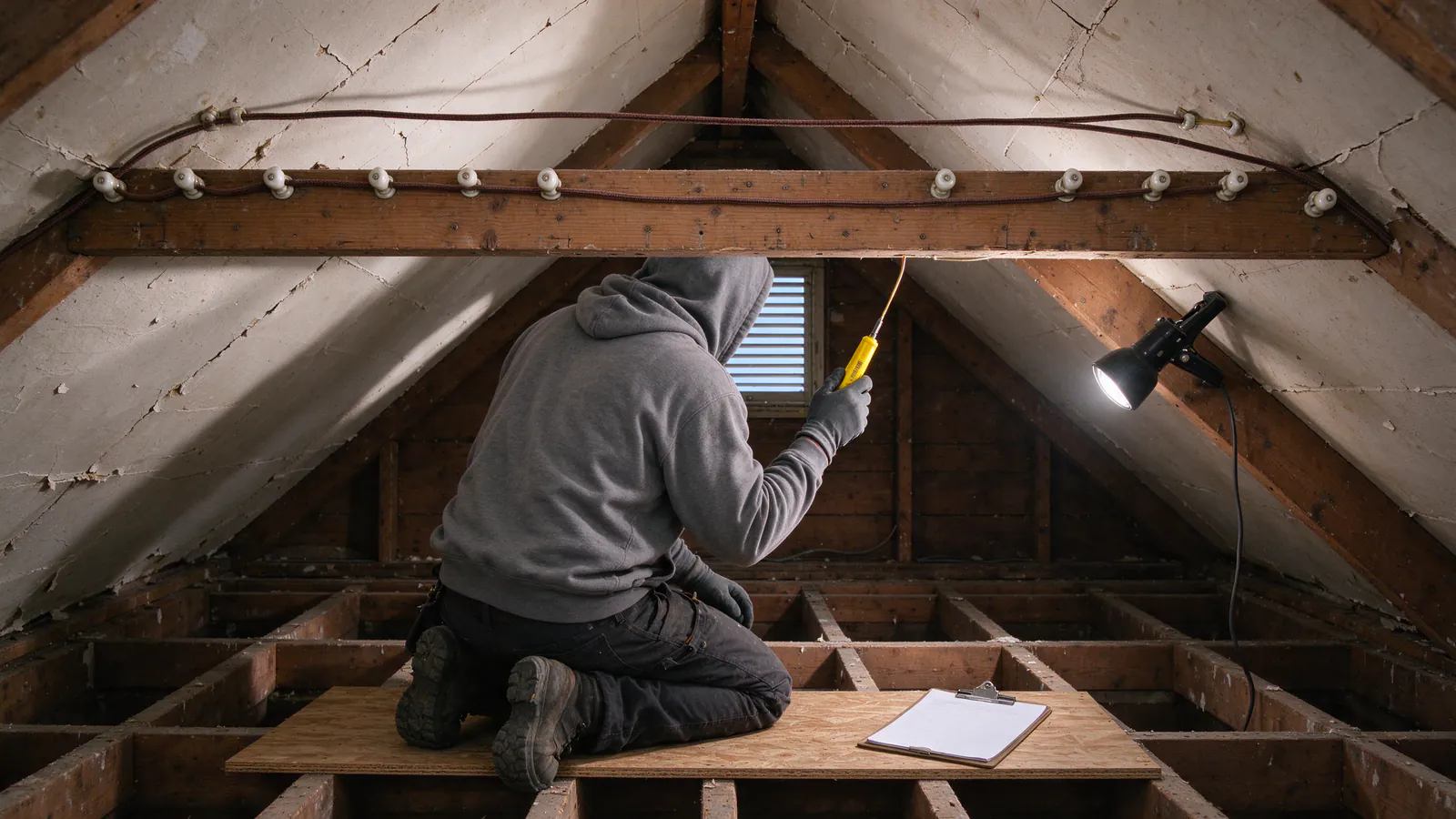
Yes. No California or San Francisco rule requires knob and tube to be replaced before a sale. Since January 1, 2026, California Civil Code 1102.6(i) has required sellers or their agents to give buyers a statement advising an electrical inspection and warning that faulty wiring may make insurance difficult to obtain. In practice the buyer’s insurer, not the law, sets the terms.
Fog City SF Knob and Tube manages knob and tube inspection and replacement in San Francisco and the East Bay, with the work carried out by licensed and insured California C-10 electrical contractors. For a seller, the choice is usually between selling with a clear record of what is in the walls and replacing some or all of it first. Either starts with a knob and tube inspection that tests every circuit and writes down what it finds.
What Civil Code 1102.6(i) requires
For sales on or after January 1, 2026, the seller or the seller’s agent must deliver a statement that it may be advisable to have a qualified professional inspect the electrical system, including the main panel, subpanels and wiring, and that “substandard, recalled, or faulty wiring may cause a fire risk and may make it difficult to obtain property insurance.” Houses within three years of their certificate of occupancy are exempt. The San Francisco Association of REALTORS revised its San Francisco seller disclosure form to deliver the statement, along with an advisory on the city’s rule for gas-to-electric replacement in certain major renovations.
The statement is the same for every house. It does not say the house has knob and tube, and it does not require the seller to inspect, repair or replace anything. Its effect is to put the electrical system on every buyer’s checklist, which is why sellers of older houses increasingly decide to get ahead of the question.
What you already know about the wiring is a separate matter from the statutory statement. How to describe known conditions in your disclosures is a question for your agent or attorney; a written circuit record makes it easy to describe them accurately.
Why buyers care: insurance and loans
A lender needs a homeowners policy before it funds a purchase loan, and some carriers decline houses with active knob and tube or insure them only on condition of replacement soon after closing. A San Francisco agent told the San Francisco Chronicle that insurance is often now the contingency of the purchase. Homeowners report a full range of outcomes, so a buyer’s carrier may or may not raise it. The California insurance guide covers what carriers ask for, and the buying guide shows the sale from the buyer’s side.
That uncertainty is what costs sellers. A buyer who does not know how much knob and tube is live, or what replacing it would cost, prices in the worst case. A seller who can show the answer narrows the gap.
Three ways to handle it
| Option | When it fits | What to prepare |
|---|---|---|
| Sell with a tested record | A few live circuits, good condition, or a tight timeline | An electrician’s circuit record, photos of attic and basement runs, any permit history |
| Offer a credit or price adjustment | Buyers will want to choose their own scope | The circuit record plus a written scope and price range for replacement |
| Replace before listing | Much of the house is live knob and tube and buyers will need financing | Permit final, Green Tag, a written circuit record and labeled panel directory |
| Replace part of it | Only a few circuits remain after earlier work | The same documents, plus a written list of anything left on knob and tube |
Replacing before listing has a timing cost. In San Francisco the work needs a DBI electrical permit, a pre-cover inspection before walls close, a final inspection and the Green Tag, and plaster patching waits for the pre-cover sign-off. The San Francisco electrical permit guide walks through that sequence, and how long it takes depends mostly on access and the number of circuits. Patching is shown as its own line in a Fog City SF Knob and Tube quote, so the condition of the walls at listing is planned rather than left to chance.
A partial replacement needs an honest record. Homeowners report buying houses described as rewired and finding knob and tube on ceiling fixtures years later. Listing exactly which circuits were replaced and which were not protects the seller as much as the buyer. Partial knob and tube replacement covers how that boundary is drawn.
Retiring dead runs before a sale
Many older houses have more abandoned knob and tube than live. Dead runs left loose in an attic look the same as live ones to a buyer’s inspector or an insurer’s photographer. San Francisco’s electrical code requires unused conductors to be removed or identified and terminated in an approved manner, and doing that before listing, with a record, can remove a question a buyer would otherwise ask. The active vs abandoned guide and knob and tube removal cover the difference and the work.
San Francisco’s time-of-sale rules: RECO
San Francisco’s Residential Energy Conservation Ordinance requires owners, before selling, to obtain a valid inspection, install basic energy and water conservation measures and obtain a certificate of compliance. The energy measures may include insulating attic space, along with weather stripping, water heater insulation, caulking and duct insulation. DBI publishes a list of certified RECO inspectors. Buildings permitted on or after July 1, 1978, or with recorded compliance, do not need the energy inspection.
Attic insulation is where RECO meets knob and tube. An older DBI and SFPUC brochure on the ordinance states that before insulation goes into areas with knob and tube wiring, the wiring must be inspected and approved by a licensed electrical contractor, and the signed approval, with the contractor’s state license number, submitted with the energy inspection report. Separately, the California Electrical Code bars insulation that envelops concealed knob and tube unless a licensed electrical contractor certifies it first. Confirm with DBI’s Housing Inspection Services how the RECO step is applied to your house; the attic insulation service covers the electrical side.
Selling in Berkeley and the East Bay
Berkeley’s Building Emissions Saving Ordinance adds its own time-of-sale step. Starting January 1, 2026, sellers of single-family homes and duplexes must get a Home Energy Score before listing and either complete upgrades worth at least six credits per unit before the sale, or defer them to the buyer with a $5,000 deposit, $2,500 each from seller and buyer, refunded after the buyer completes the upgrades within two years. Knob and tube replacement with four 240-volt receptacles, one each for the water heater, heating, dryer and range, is a six-credit measure on its own, verified by a permit with a final inspection whose scope states it is for BESO compliance. See Berkeley.
In Oakland, Piedmont and the other East Bay cities, time-of-sale and code requirements are confirmed per address with each city.
Listing a house with knob and tube?
Start with a tested circuit record, so buyers and their insurers see exactly what is live and what replacing it would involve.
Records to have ready
- The electrician’s circuit record, with each circuit’s wiring type and whether it is live
- Permit numbers, final inspections and Green Tags for any past electrical work
- A labeled panel directory
- Photos of attic and basement runs, taken without disturbing the wiring
- Any insurer correspondence about the wiring
- For a partial job, the written list of what remains
Those same records serve the buyer’s carrier, and they are what the resources page checklist asks buyers to request. Planning a listing? Call (628) 296-7628 or request an estimate with your target listing date.