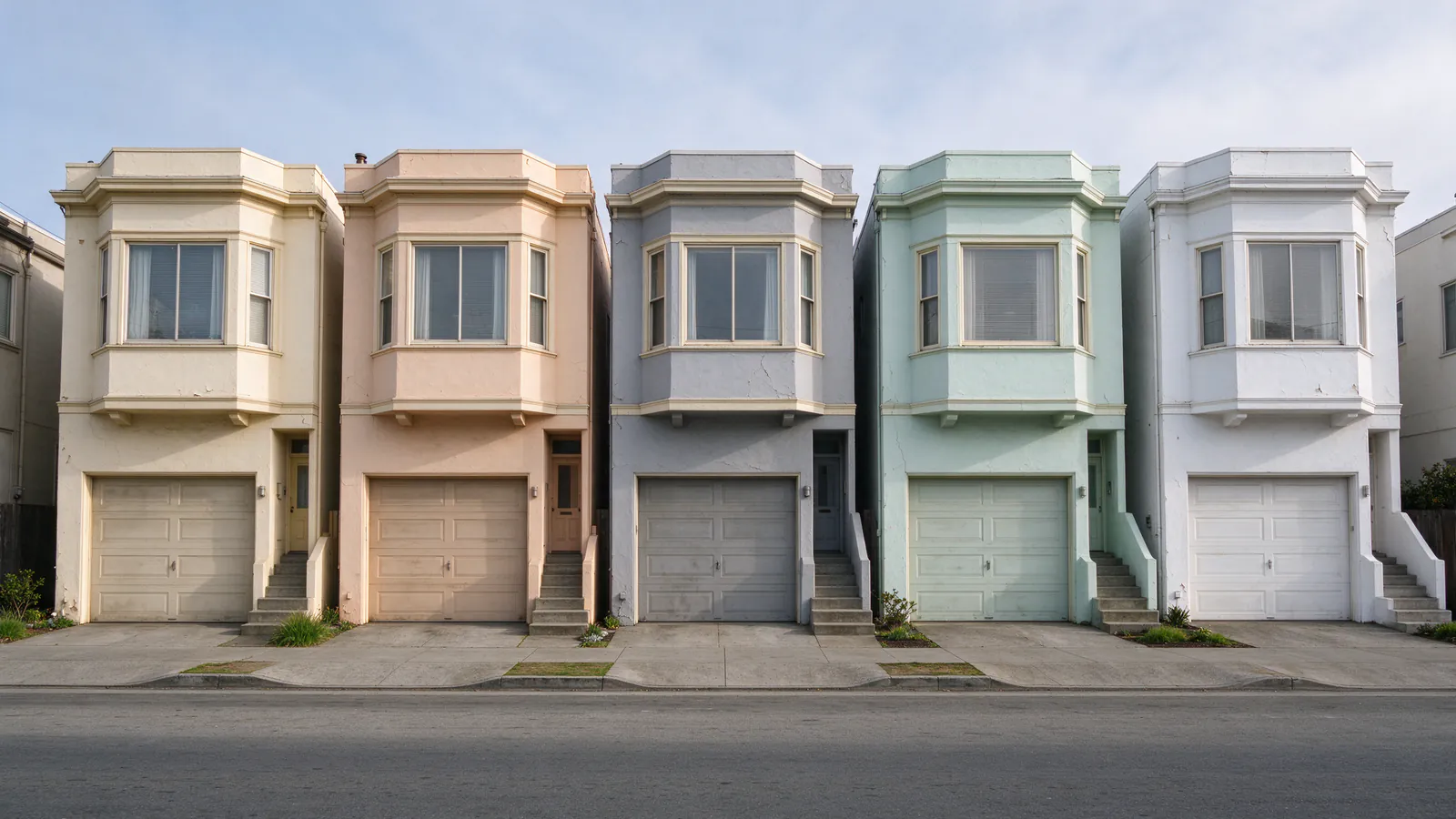
In the Sunset, the first question about knob and tube is whether a house has any at all. Most of the district was built between 1925 and 1950, the years when wiring practice was moving away from porcelain knobs, so a 1928 house and a 1948 house a few blocks apart can hold very different wiring behind the same stucco front.
Fog City SF Knob and Tube manages knob and tube testing and replacement in the Outer, Central and Inner Sunset, Parkside and the Excelsior under San Francisco DBI permits, and licensed and insured electrical contractors carry out the electrical work. Because the answer here is so often “some, not all,” a Sunset job starts with a knob and tube inspection rather than a whole-house price.
Which side of the knob and tube era is a Sunset house on?
Often both. Houses from the 1920s and early 1930s are the likeliest to have original knob and tube, while late-1930s and 1940s tract houses may have later cable, or a mix of the two joined by splices. That is an inference from building dates, not a record of any particular house, so only a circuit-by-circuit test settles it.
The dates are well documented. SF Planning’s Sunset District Residential Builders context statement, adopted in 2013, finds that the vast majority of the district’s construction happened from 1925 to 1950. Census figures show it: only 36.1% of Sunset/Parkside housing units were built before 1940, but 68.2% were built before 1950, and 9,283 units date from the 1940s alone. ZIP 94116 makes the biggest jump in the city, from 33.7% of units built before 1940 to 69.0% before 1950. The same study notes that by the late 1930s the large merchant builders ran specialized crews for foundations, framing, sheetrock, siding and roofing, while one builder’s 1935 sales booklet still advertised local contractors for electrical work and plastering. A Sunset house can have plaster or early wallboard, and wiring from either side of the change. The guide to identifying knob and tube explains what can be seen without opening anything.
Twenty-five-foot lots and the garage below
The context statement describes the typical Sunset house as a stucco single-family house with an integrated garage at the ground story and living space above, tightly packed on 25-foot lots, a one-story-over-garage format with no known examples outside San Francisco and, later, Daly City. For wiring, that form decides the route. Shared side walls leave no side yard to work from, so the garage ceiling under the living floor is usually the way in: new circuits run along the joists and turn up into the walls of the rooms above, with small openings at outlets and switches.
Where the garage ceiling has been drywalled, it is opened in places, and the patching is listed in the quote. And San Francisco’s electrical code treats wiring less than 8 feet above a walking surface as subject to physical damage, so cable that drops down a garage wall to a panel or a laundry outlet needs protection. Above the top floor, conditions vary from house to house; where there is a reachable attic or crawl space, the upper runs are fished from there.
What the walk-through has to settle
Sunset permit records show how often the job is partial. DBI’s records on DataSF include 188 electrical permits naming knob and tube in Sunset/Parkside and 97 in the Inner Sunset from January 2016 to October 2026, beside 356 Sunset/Parkside permits that describe a whole-house rewire. The descriptions read like the houses: “remove the old knob and tube and update sub panel,” or an Inner Sunset permit that replaced an old breaker panel like for like and then de-energized the knob and tube and replaced it with new cable.
The walk-through tests every circuit and records which run on knob and tube, which on later cable and which are spliced together. That record decides the scope: a partial replacement of the circuits still live, or a whole-house rewire when most of the house is original or the eras are tangled together. A panel change on its own replaces no branch wiring, so a newer breaker panel says nothing about what feeds the bedrooms.
Attic insulation, RECO and a sale
The California Electrical Code does not allow concealed knob and tube in attics or walls where loose, rolled or foamed-in insulation envelops the conductors, unless a California-licensed electrical contractor surveys the wiring, certifies its condition and files that certification with the building department, among other conditions. San Francisco’s Residential Energy Conservation Ordinance requires an inspection and basic energy measures before a home is sold, and those measures may include insulating attic space. No city guidance was found on how RECO handles an attic with live knob and tube, so the order of work is confirmed per address: usually test first, then replace or certify, then insulate. The attic insulation service covers that sequence, and the guide to selling a house with knob and tube covers the rest of a sale.
BayREN’s EASE Home program ties the two jobs together: for income-qualified PG&E customers in homes of four or fewer units built before 2010, it reimburses up to $2,000 to fix active knob and tube within a weatherization project, and BayREN also announced $300 for a certification that it is inactive, which is worth confirming with BayREN because the program page does not list it. The contractors supply the invoice or certification and the company helps with the paperwork; BayREN decides eligibility, as the BayREN rebate guide explains.
One permit for one house
Most Sunset jobs take a single DBI permit. Census figures count 6,216 owner-occupied single-family homes built before 1940 in Sunset/Parkside and 8,929 more built from 1940 to 1959, and only 32.6% of the occupied pre-1940 units are rented. A single-family dwelling is an R-3 occupancy, so it needs one electrical permit rather than one per unit. An owner who lives in a stand-alone house may take out a homeowner permit, but DBI requires that owner to do the work personally. Not every building is a single house, though: one 94116 permit called for a new overhead service for both units, at 125 amps each, and knob and tube replacement in both, which means a permit for each dwelling unit. The San Francisco permit guide walks through DBI’s process.
Not sure how much knob and tube is left?
A circuit-by-circuit test of a Sunset house shows what is live, what is abandoned and whether the garage ceiling is the way in.
From first call to Green Tag
The first call covers the build year, any remodels, the panel or fuse box, and what prompted the call: a sale, an insurer or planned insulation. The walk-through tests every circuit and checks the garage ceiling, the attic and the panel location. The written scope and price list each opening and who closes it, with plaster and wall patching shown as its own line. After DBI’s pre-cover inspection, the openings are closed, and the final inspection leads to the Green Tag. Old runs are disconnected at both ends, removed where reachable and otherwise terminated, and the house gets a written circuit record and a labeled panel directory.
Excelsior, Outer Mission and Ingleside
The same Planning study records that the Excelsior was built out from the 1920s through the 1940s with tract housing, primarily single-family dwellings with integral garages, so the Sunset decision carries across the city’s southern edge. ZIP 94112 has more owner-occupied single-family homes built before 1940 than any other San Francisco ZIP, an estimated 8,328, and only 22.7% of the Excelsior’s occupied pre-1940 units are rented. DBI’s records show 45 knob and tube permits in the Excelsior, 29 in the Outer Mission and 24 in Oceanview/Merced/Ingleside over the same window, and one Ingleside-area permit reads “rewire remaining knob and tube wiring in home.”
94112 also had 248 California FAIR Plan residential policies in September 2025, up from 32 in September 2021, the most of any San Francisco ZIP. The figures give no reason for any policy, so on their own they say nothing about wiring. Where an insurer does ask about knob and tube, an electrical inspection for insurance documents what is in the house, though the carrier still decides. Ingleside Terraces, a residence park of detached houses, is covered on the West of Twin Peaks page. For budgets, the San Francisco cost guide explains the ranges, and other neighborhoods are listed on the service areas page.