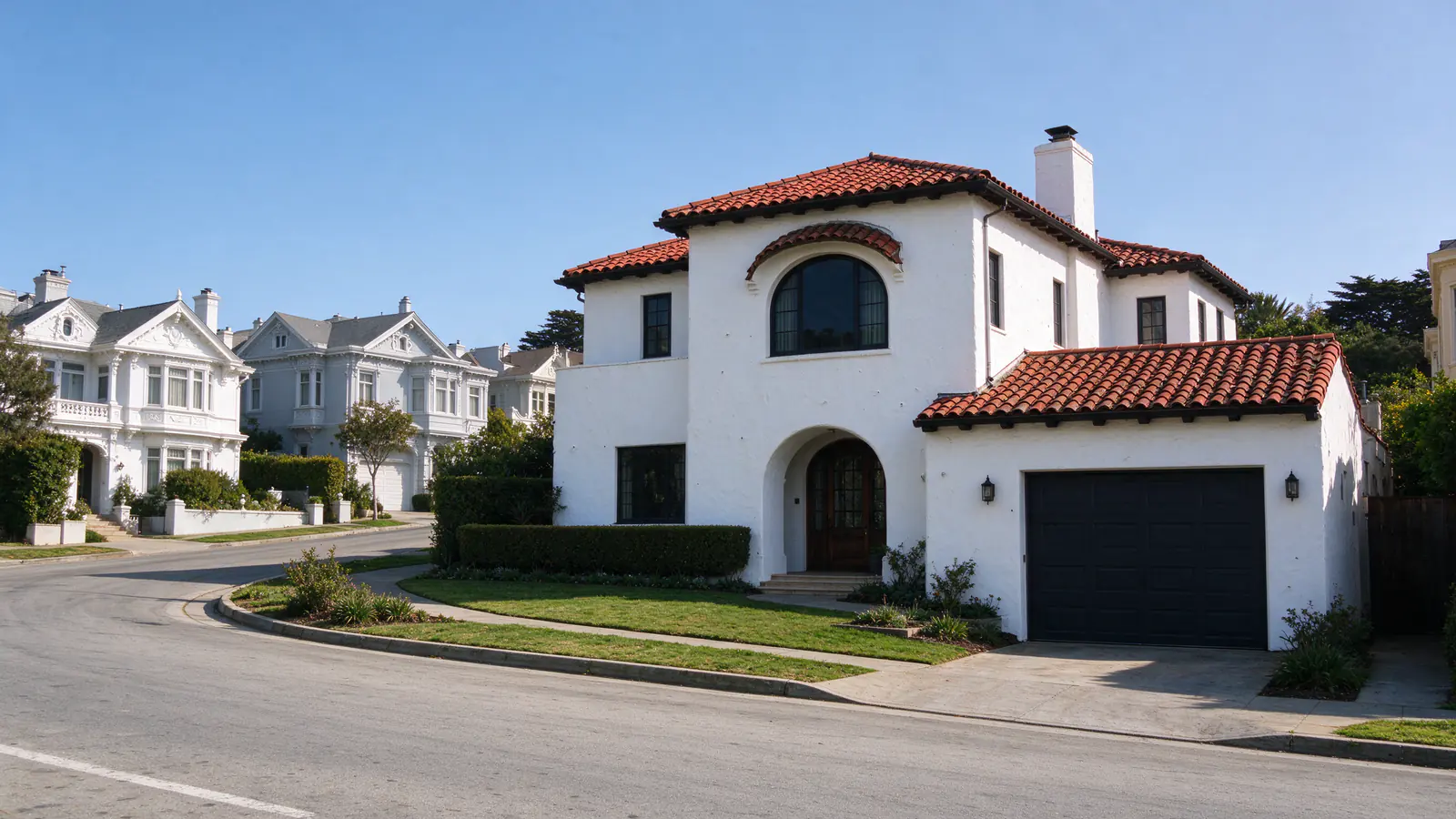
In Forest Hill, electricity reaches the house underground. A few blocks south, below Darien Way in Balboa Terrace, it comes from a pole in the service alley behind the lot. That difference stays invisible until a knob and tube rewire adds a panel and service upgrade, and then it decides where the new meter can go, what PG&E has to do and what the upgrade costs.
Fog City SF Knob and Tube manages knob and tube replacement in Forest Hill, St. Francis Wood, Balboa Terrace, West Portal, Westwood Park, Monterey Heights and Miraloma Park under San Francisco DBI permits. The electrical work is carried out by licensed and insured electrical contractors, and every job here starts with a test of each circuit in the house.
Underground, overhead or from the alley?
Each is possible west of Twin Peaks, and the answer matters only when the job includes a service upgrade. Forest Hill and the blocks of Balboa Terrace north of Darien Way are served underground, and the blocks south of Darien from alley poles. Elsewhere, and for any single house, PG&E confirms how the service arrives.
The source is Planning’s study of the residence parks, which records that in Forest Hill the street views are “enhanced by the location of utilities underground” and that in Balboa Terrace utilities are underground north of Darien Way while poles stand in the service alleys to the south. For an underground-fed house, a larger service means PG&E underground work rather than a new overhead drop, and underground service with trenching can run past the $10,000 top of the typical San Francisco range for a panel and service upgrade. On an alley-fed lot, the meter and panel usually belong on the rear, which can shorten the run to a basement panel or lengthen it to one at the front. San Francisco’s electrical code requires service-entrance conductors to run in a raceway such as rigid conduit, and PG&E needs an application before it changes anything outside the house. The rewire itself, the branch circuits inside, works the same on all three. A new panel by itself removes no knob and tube, which the panel upgrade vs rewiring guide explains.
A planning study that was never adopted
The study behind this page is a draft. SF Planning’s “Gardens in the City: San Francisco Residence Parks, 1906-1940” is dated October 2016, was presented to the Historic Preservation Commission at an informational hearing on April 7, 2021, and is listed by Planning as ongoing. It has not been adopted, so its descriptions are a historian’s account prepared for Planning rather than an official finding, and nothing in it is a rule.
It is still the best description of these neighborhoods. The draft studies eight residence parks, including Forest Hill, St. Francis Wood and Balboa Terrace here and Ingleside Terraces just south, and finds them exclusively residential, built with detached single-family houses under deed restrictions. Garages were often detached structures or inserted into the lower levels of houses. The same developer behind some of these parks also built Westwood Park, Westwood Highlands, Monterey Heights, Mission Terrace and Geneva Terrace. Planning’s historic districts layer shows no Article 10 landmark district west of Twin Peaks, so interior rewiring here meets no historic review. Miraloma Park appears in survey findings as a California Register-eligible district; what that means for exterior work such as a new mast is confirmed per address.
Detached houses give the wiring more ways in
An attached Sunset row house usually has one route, the garage ceiling. A detached house on a residence-park lot has more: side and rear walls, a basement or lower-level garage, and, where there is one, an attic. Where the house and its finishes allow, runs can go up through a closet, along a basement ceiling and into an attic, reaching rooms with small openings at outlets and switches instead of long cuts across finished walls. No house is rewired without some openings, and the written scope lists each one and who closes it, with plaster patching on its own line. Larger houses mean longer runs and more circuits, which is why house size and access drive the price more than the neighborhood does.
Built in 1915 or built in 1935
The draft study finds that in the larger residence parks, such as St. Francis Wood and Ingleside Terraces, the houses built during the 1910s were generally larger than those of the 1920s and 1930s. The wiring follows the date. A 1910s house is squarely from the knob and tube era and the likeliest to hold original runs, often extended by later remodels; a 1930s house may have transitional wiring or a mix. That is an inference from building dates, not a record of any particular house. A circuit-by-circuit test shows which circuits are live knob and tube, which were abandoned in place and which were replaced, the difference the guide to active and abandoned knob and tube explains.
The busiest knob and tube record in the city
West of Twin Peaks has more electrical permits naming knob and tube than any other San Francisco neighborhood: 211 in DBI’s records on DataSF from January 2016 to October 2026, or 24.4 of every 1,000 electrical permits filed there, plus 278 permits that describe a whole-house rewire. ZIP 94127 alone accounts for 129. One reads simply “partial re-wire remove knob and tube.”
The households explain the pattern better than the age does. Census figures put 51.5% of the neighborhood’s housing units before 1940 and 65.6% before 1950, but the striking number is tenure: 6,331 owner-occupied single-family homes built before 1940, and only 12.1% of occupied pre-1940 units rented, against 57.4% citywide. A single owner deciding about a single house, under one R-3 permit, is the common case here. Whether the job ends up a whole-house rewire or a partial replacement depends on what the test finds.
Planning a rewire and a new service?
Start with a test of every circuit and a check of how PG&E serves the lot: underground, overhead or from the alley.
What the first visit checks on a detached house
The first call covers the year the house was built, the remodels since, the panel or fuse box, and whether a service upgrade is wanted for a kitchen, a heat pump or an EV charger. The walk-through tests every circuit, then looks at the routes: basement, crawl space, attic, closets, side and rear walls. It also notes where the service enters and where the meter sits.
The written scope and price list each opening and who closes it. The DBI permit is filed, and if the service changes, the PG&E application goes in alongside it. Attic and basement routes are used first, and the pre-cover inspection comes before any wall is closed. Where the service was changed, PG&E reconnects it after the final inspection and the Green Tag. Old runs are disconnected at both ends, removed where reachable and otherwise terminated under knob and tube removal, and the house gets a written circuit record and a labeled panel directory. The replacement process guide walks through each stage, and the permit guide covers DBI’s side.
Westwood Park, Miraloma Park and Ingleside Terraces
DataSF’s West of Twin Peaks boundary takes in Ingleside Terraces and the nearby residence parks as well as St. Francis Wood, Forest Hill, West Portal, Miraloma Park and Balboa Terrace. Ingleside Terraces is one of the eight parks in the draft study and shares the detached-house decision. Westwood Park and Monterey Heights came from the same developer as several of the parks, though the draft study’s eight do not include them, so their house forms are checked one by one. Where a house is a stand-alone single-family home and the owner’s primary residence, the owner may take out a homeowner permit, but DBI requires the owner to do the work personally.
For budgets, the San Francisco cost guide explains the ranges. Sea Cliff and the Richmond’s residence parks are covered on the Richmond District page, and other neighborhoods are on the service areas page.