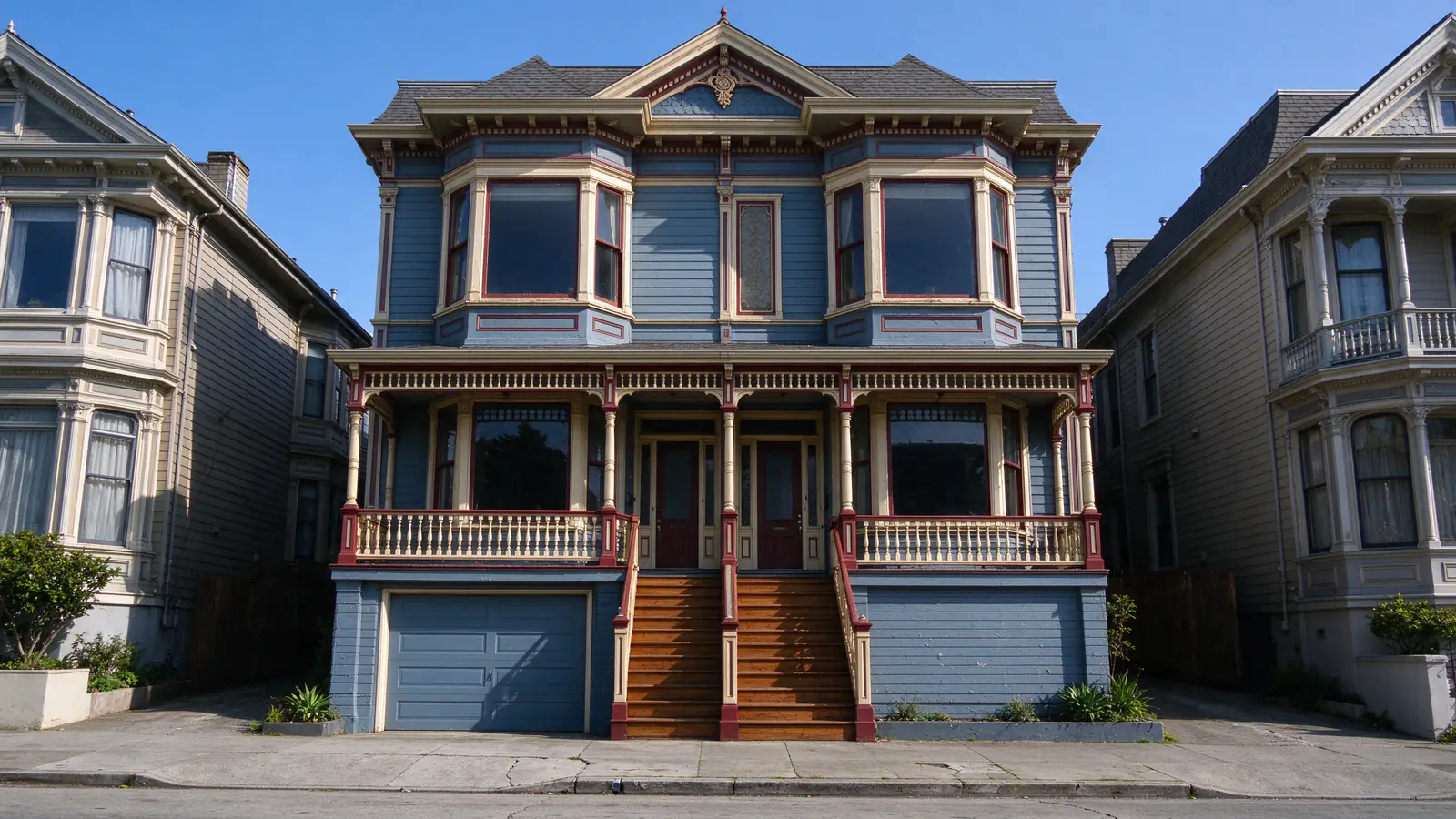
A Haight flat building with the owner upstairs and a tenant downstairs raises a question a single house never does: rewire one unit now, or the whole building at once. Each answer brings its own permits, power-off schedule and effect on the person living below.
Fog City SF Knob and Tube plans and manages knob and tube replacement in Haight-Ashbury, Cole Valley, Duboce Triangle, Alamo Square, the Castro and Noe Valley under San Francisco DBI permits. Licensed and insured electrical contractors carry out the electrical work, and in a building with tenants, every power-off window is announced to residents ahead of time.
Your flat, or the whole building?
Either can work. DBI issues a separate electrical permit for each existing dwelling unit, so one flat can be rewired on its own permit while the other waits. The catch is shared wiring: where a lower flat’s ceiling carries circuits for the unit above, or a common meter and hallway circuits serve both, rewiring one unit reaches into the other.
This setup is common here. ZIP 94117 holds an estimated 2,132 owner-occupied homes built before 1940 in buildings of two to four units, more than any San Francisco ZIP except 94110. The walk-through tests circuits in every unit the owner can open, because a circuit that starts at one flat’s fuse block can end at a light in the other, and that test, not the unit boundary, sets the phasing. In citywide DBI records, 564 of the 2,023 knob and tube permits filed from 2016 mention a subpanel, which is usually how each flat gets its own new distribution point. Apartment building rewiring covers multi-unit phasing, and the condo and TIC guide covers buildings where each flat has a different owner.
The oldest housing in San Francisco, by share
Census figures put 71.2% of Haight Ashbury housing units before 1940, the highest share of any San Francisco neighborhood, and ZIP 94117 at 69.7%, the highest of any ZIP. That age shows in the permit record. DBI’s data lists 109 electrical permits naming knob and tube in Haight Ashbury from January 2016 to October 2026, and 203 in 94117 once PermitSF filings are added. The rate says more than the count: 27.9 of every 1,000 electrical permits filed in the neighborhood since 2016 name knob and tube, among the highest in San Francisco, next to Presidio Heights at 28.8.
Age is context, not a diagnosis. Where a Victorian or Edwardian flat has been partly rewired before, the usual result is a mix: original knob and tube in some rooms, later cable in a remodeled kitchen, and splices joining the two inside a wall or ceiling. One 94117 permit for a kitchen, bathroom and powder room remodel also replaced the existing knob and tube and added lights and a laundry outlet in the garage. Remodels are often when the remaining circuits come to light, which is the case remodel knob and tube replacement covers.
Getting new wiring into a stacked flat
Access depends on what sits above and below each unit. The lowest flat can often be reached from a basement or garage ceiling. A middle flat has finished floors above and below it, so circuits are fished through the walls from small openings at outlets, switches and the tops of walls. The top flat may have an attic or crawl space overhead, or, under a flat roof, nothing walkable at all. Victorian and Edwardian rewiring covers the plaster and trim of buildings this age, and plaster-wall rewiring covers how openings are kept small. Plaster patching is included and shown as its own line in the quote.
Opening plaster in an older building also brings in lead-safe practice. DBI presumes buildings built before 1979 contain lead paint unless a certified inspector shows otherwise, and its safety guide calls for notifying neighbors at least three business days before work and containing dust while it happens. The lead and asbestos guide explains what that adds.
Alamo Square and Duboce Park
Two of San Francisco’s Article 10 landmark districts sit in this area: Alamo Square, designated in 1984, and Duboce Park, designated in 2013. DBI’s permit data puts 4 knob and tube permits filed since 2016 inside Alamo Square and 5 inside Duboce Park; counting every knob and tube or rewiring permit since 2002, the totals are 89 and 32.
Planning’s Preservation Bulletin 4 requires a Certificate of Appropriateness in these districts for alterations that need a permit and for other exterior changes visible from a public street, and the Planning Code exempts interior alterations. Rewiring inside the building therefore needs no historic review. The service is another matter. San Francisco’s electrical code requires service-entrance conductors to run in a raceway such as rigid conduit, so a panel and service upgrade that moves the meter or adds a mast or conduit on a street-facing facade is an exterior change. Planning offers a staff-level administrative Certificate for minor alterations, but whether a given meter or mast change qualifies is confirmed with Planning per address, and leaving the service where it already sits is one option to weigh before applying.
When the other unit is rented
Census figures show 65.6% of occupied pre-1940 units in Haight Ashbury are rented, so many buildings here have at least one rented unit. Most rewiring can be done with residents at home, room by room, with power off only during announced windows; the guide to living at home during a rewire describes what that is like. If a tenant must leave temporarily for capital improvement work, the Rent Ordinance requires the landlord to file with the Rent Board within ten days of serving notice and to pay relocation expenses. The Rent Board defines a capital improvement as one that materially adds to the value of the property or appreciably prolongs its useful life; whether a given rewire qualifies for a passthrough is the Rent Board’s call, and the rental property guide explains the petition.
Rewiring one flat or both?
Start with a test of the circuits in each unit, so the plan follows the wiring instead of the floor line.
How a two-flat rewire is sequenced
The first call settles which units the owner can open, who lives in each, whether the building is in Alamo Square or Duboce Park, and what started the question: a remodel, an insurer or a sale. The walk-through tests every circuit in each unit and traces the shared ones, then checks the basement or garage, the meter bank and whether the building is on DBI’s soft-story list, which includes 329 Haight Ashbury properties. The written scope and price follow unit by unit, listing each opening and who closes it.
Permits are filed per dwelling unit, and each unit gets its own pre-cover inspection before walls close and its own final inspection and Green Tag. Old runs are disconnected at both ends, removed where reachable and otherwise terminated. Each unit receives a written circuit record and a labeled panel directory.
Castro and Noe Valley
The Castro’s building pattern is unusually well documented. SF Planning’s Eureka Valley context statement, adopted in 2017, records that by 1900 its blocks had filled in with single-story-over-basement houses, two-story flats and fewer side-by-side duplexes and three-story flats, and that the two-flat form spans nearly eighty years of construction. Early two-flats usually sit on high basements, which let owners insert garages later. That garage is the way in from below for the lower flat, and because San Francisco’s code treats wiring less than 8 feet above a walking surface as subject to damage, low runs there need protection.
Census figures put Castro/Upper Market at 60.1% pre-1940 and Noe Valley at 54.9%, with roughly half of each neighborhood’s occupied pre-1940 units owner-occupied. ZIP 94114 counts an estimated 2,096 owner-occupied pre-1940 homes in two- to four-unit buildings. DBI’s records show 109 knob and tube permits in Castro/Upper Market and 93 in Noe Valley from January 2016 to October 2026, among them “rewire of apartment to remove knob and tube. subpanel in unit.” and a Noe Valley permit to “remove remaining knob and tube in rooms referenced,” the partial job again. Noe Valley has no Article 10 district and no Planning context statement of its own, so its building forms are checked house by house.
For costs, the San Francisco cost guide explains the ranges, and other neighborhoods are on the service areas page.