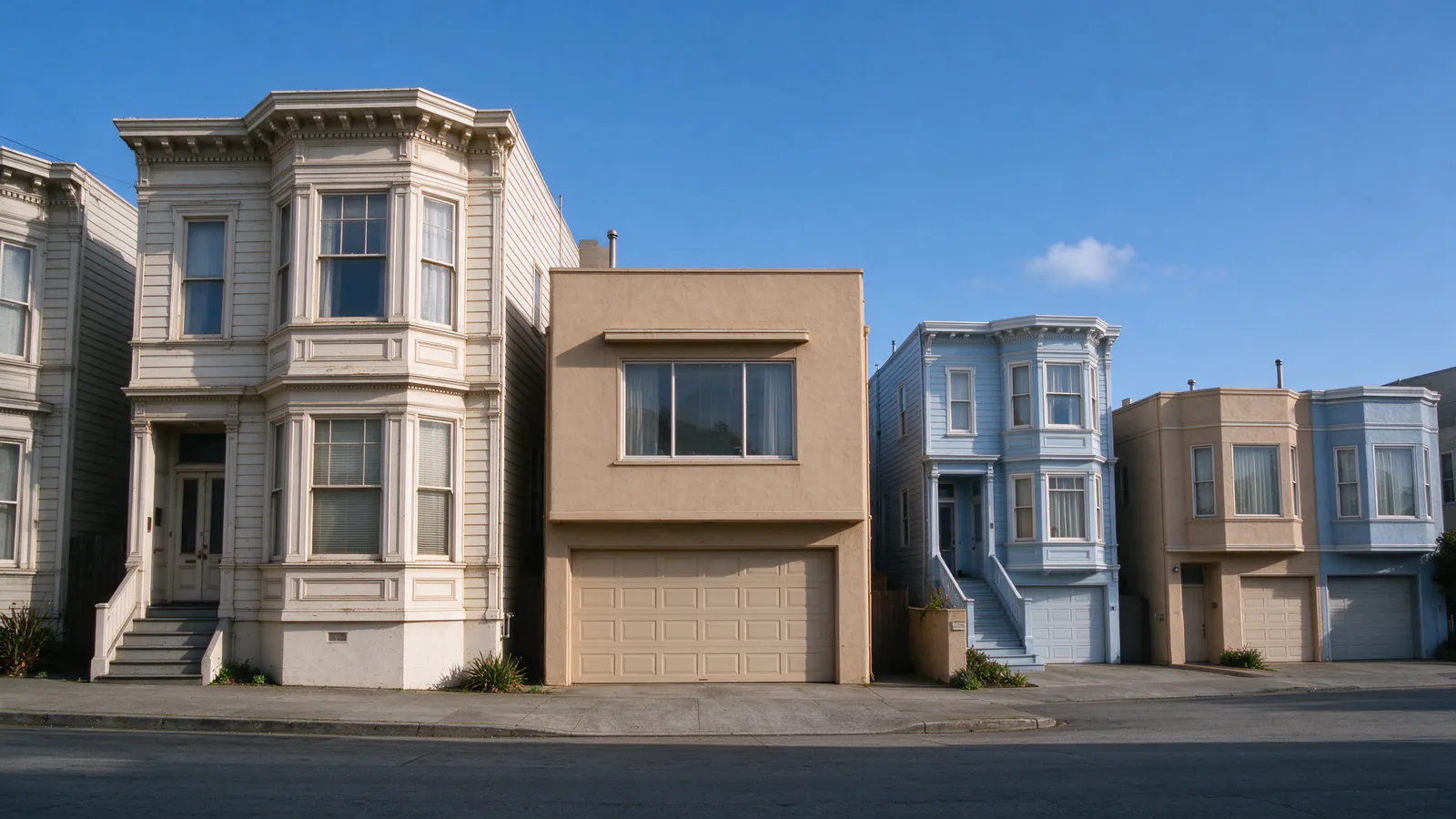
The Richmond District does not have one kind of house, and for knob and tube the kind of house matters more than the address. An Inner Richmond two-flat from the 1890s, a 1930s house over a garage near Ocean Beach and a detached Sea Cliff house fed by underground power need three different plans, even though DBI, PG&E and the code are the same for all of them.
Fog City SF Knob and Tube manages knob and tube replacement across the Inner and Outer Richmond, Lone Mountain, Presidio Heights and Sea Cliff under San Francisco DBI permits, and the electrical work is carried out by licensed and insured electrical contractors. The first step is the same for every type: a knob and tube inspection that tests each circuit and records what it runs on.
Which Richmond house type do you have?
Most Richmond buildings fall into one of three types, and each points to a different scope. Older Inner Richmond houses and two-flats are the likeliest to have original knob and tube and may need a permit per unit. Tract houses over garages toward Ocean Beach may have little or none. Residence-park houses are detached and sometimes fed underground.
| House type | Where and when | Likely wiring | Permits | Usual way in |
|---|---|---|---|---|
| Houses and two-flats | Inner Richmond, 1890s to 1910s | Original knob and tube, often partly replaced | One per dwelling unit | Basement or garage ceiling, then fishing through plaster |
| Tract houses with integral garages | Toward Ocean Beach, 1920s to 1940s | Knob and tube, a mix or later cable | One (R-3) | Garage ceiling under the living floor |
| Detached residence-park houses | Sea Cliff, Jordan Park, West Clay Park, Lincoln Manor, 1906 to 1940 | Varies with the build date | One, except duplexes in Jordan Park | Side and rear walls, basement, attic; service may be underground |
The “likely wiring” column is an inference from building dates, not a finding about any house. Only a circuit-by-circuit test shows what a particular building holds.
Inner Richmond houses and two-flats
The Richmond was platted by 1870, but houses came later. Planning’s draft residence parks study, which includes a history of the city’s west side, records that development began in the 1880s and 1890s with working-class and middle-class owner-occupants building single-family houses and two-flats, alongside speculative builders putting up rows of nearly identical dwellings; transit lines reaching the Inner Richmond in the 1890s began what it calls the real movement to residential development. Census figures put the Inner Richmond at 59.6% pre-1940, and half of its occupied pre-1940 units, 50.9%, are rented. ZIP 94118 counts an estimated 1,593 owner-occupied pre-1940 homes in buildings of two to four units.
That makes the Inner Richmond’s older stock a flats decision. Each existing dwelling unit takes its own DBI permit, a tenant may live in one of them, and circuits for an upper flat can run through the ceiling of the one below. Where a building of this age has been partly rewired, knob and tube may remain in some rooms and be spliced to later cable in others; one Inner Richmond permit reads simply “disconnect knob and tube and replace with romex wiring.” Victorian and Edwardian rewiring covers buildings of this age, and the Haight-Ashbury page covers owner-occupied flats in more depth.
Tract houses toward Ocean Beach
West of the older blocks, the Richmond changes. SF Planning’s Sunset District context statement, adopted in 2013, records that vast areas of the Sunset and Richmond Districts were built out from the 1920s through the 1940s with tract housing, primarily single-family dwellings with integral garages, and that by 1948 one of the largest Sunset builders had expanded into the Richmond. Census figures put the Outer Richmond at 56.4% pre-1940 and 64.4% pre-1950, with 4,154 owner-occupied single-family homes built before 1940.
These houses date from the end of the knob and tube era, so the question is how much is left rather than how to replace all of it. The garage ceiling under the living floor is usually the way in, and San Francisco’s electrical code treats wiring less than 8 feet above a walking surface as subject to damage, so cable running down a garage wall needs protection. Depending on what the test finds, the scope is a partial replacement or a whole-house rewire. The Sunset page treats this house type in detail.
Sea Cliff, Jordan Park and the residence parks
Four of the eight residence parks in Planning’s draft study are in or beside the Richmond: Jordan Park, West Clay Park, Sea Cliff and Lincoln Manor. The study, dated October 2016 and never adopted, describes detached single-family houses on deed-restricted tracts, except in Jordan Park, which allowed duplexes and some other multi-family buildings. It records that Sea Cliff’s utilities are underground and that its builders placed detached garages at the rear of lots when they could; a 1910 West Clay Park advertisement promised underground telephone and electricity to the curb line; Presidio Terrace’s utilities were also set underground, while Lincoln Manor’s utility poles stand in its internal alleys.
For a rewire alone, none of this changes much: the branch circuits inside a detached house have more route options than an attached one, through side walls, basements and attics. It matters when a panel and service upgrade is part of the job. An underground-fed house means PG&E underground work, and underground service with trenching can run past the $10,000 top of the typical San Francisco range for a panel and overhead service upgrade. The West of Twin Peaks page covers the residence-park decision more fully, and the panel upgrade vs rewiring guide explains why a new panel alone removes no knob and tube.
Not sure which type your house is?
A walk-through dates the wiring, not just the house, and shows which route in fits the building.
Ground floors and the soft-story list
DBI’s soft-story program list includes 331 Outer Richmond properties, 228 in the Inner Richmond, 126 in Presidio Heights and 14 in Seacliff. A retrofit works at the ground floor, the same garage and basement ceilings that carry wiring up into the units above, and electrical permits citing soft-story work appear in both halves of the district over the years, 7 in the Inner Richmond and 5 in the Outer. Where a building is on the list, the walk-through checks whether its retrofit is done, because new runs then go through retrofitted walls, or still ahead, because planning the two together avoids opening the ground floor twice. The soft-story and rewiring article covers that coordination.
What the permit record shows in 94118 and 94121
DBI’s records on DataSF include 355 electrical permits naming knob and tube from January 2016 to October 2026 across the Richmond’s neighborhoods: 135 in the Outer Richmond, 81 in Presidio Heights, 65 in the Inner Richmond, 55 in Lone Mountain/USF and 19 in Seacliff. By ZIP, adding PermitSF filings, 94118 has 177 and 94121 has 145. Presidio Heights stands out for its rate, 28.8 of every 1,000 electrical permits, among the highest in the city; a typical description there is “rewire outlets that have knob and tube, bedroom, living room, hallway and bathroom.”
Insurance appears in this record too. California FAIR Plan figures show 100 residential policies in force in 94121 and 94 in 94118 in September 2025. The figures give no reason for any policy, so they say nothing about wiring on their own; the knob and tube insurance guide covers what underwriters ask, and the guide to buying a house with knob and tube covers an inspection before closing.
Starting a Richmond job
The first call asks the questions the table above depends on: when the building was built, how many units it has, who lives in each, whether there is a garage under the living floor, and what prompted the call. The walk-through tests every circuit, checks the garage, basement and attic routes, and notes how the service arrives. The written scope and price list each opening and who closes it, with plaster patching as its own line. Permits are filed per dwelling unit where there is more than one. After the pre-cover and final inspections and the Green Tag, old runs are disconnected at both ends, removed where reachable and otherwise terminated, and each unit gets a written circuit record and a labeled panel directory. For budgets, see the San Francisco cost guide; other neighborhoods are on the service areas page.