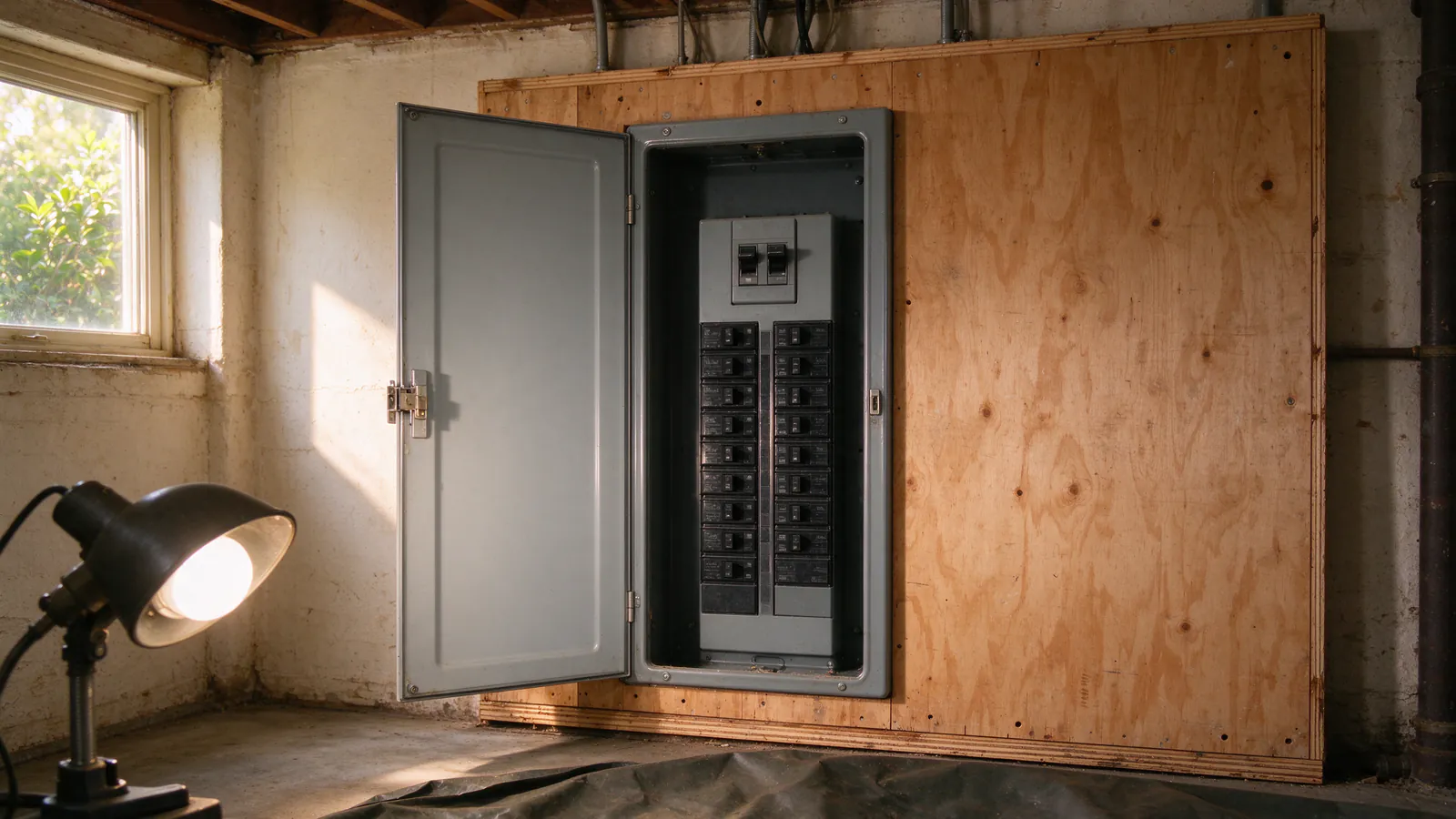
Knob and tube has no single amp rating printed on it. What a circuit can safely carry depends on the size of its copper conductors, the condition of their rubber insulation, whether they still run in open air, and whether the fuse or breaker on that circuit matches the conductor. An electrician confirms those at the panel and along the run; the age of the wiring alone does not tell you.
Fog City SF Knob and Tube manages knob and tube replacement and whole-house rewiring in San Francisco and the East Bay, carried out by licensed and insured California C-10 electrical contractors. This guide explains what sets a knob and tube circuit’s capacity, why modern loads strain it, and what to do instead of guessing.
Why there is no number on the wire
The rating people are asking about is ampacity: the current a conductor can carry continuously under its installation conditions without overheating its insulation. It is not a fixed property of the copper. The same conductor can carry more in open air than bundled in a cable, and less when its insulation is covered or has aged. Modern cable prints its conductor size on the jacket so an electrician can match it to the right breaker. Knob and tube conductors carry no such label that a homeowner can read, and decades of heat and handling have changed the insulation the original rating assumed.
So the honest answer has three parts: what size the conductor is, what condition it is in, and what is protecting it.
What sets a knob and tube circuit’s capacity
Conductor size
Larger conductors carry more current. An electrician identifies the size of each circuit’s conductors, which is not always the same along one circuit if later work spliced in a different size. A circuit is only as capable as its smallest conductor.
Open air
Knob and tube was designed to shed heat into open cavities, which is part of why the separated conductors held up as well as they did. Anything that removes the air changes that. The California Electrical Code bars concealed knob and tube where loose, rolled or foamed-in-place insulation envelops the conductors, except under a narrow certification by a licensed electrical contractor. A run buried in attic insulation cannot be assumed to carry what the same run did in open air. The attic insulation service covers that certification or the rewiring that clears the way.
Insulation condition
The rubber insulation under the cloth covering hardens and cracks with age and heat. Current itself does not crack it, but sustained heat speeds the process, and a circuit that has run warm for years, near a ceiling fixture or behind a heater outlet, is where the insulation is usually in the worst shape.
The fuse or breaker
The protection on a circuit is supposed to match its conductor, so the fuse or breaker opens before the wire overheats. That only works if the right size is installed, which is where old fuse boxes go wrong.
Overfusing: when the protection stops protecting
When an original circuit kept blowing its fuse, a common response was to screw in a larger one. That ends the nuisance, but it lets more current through a conductor that was never meant to carry it, so the fuse no longer protects the wire. The same mistake can carry into a new panel if old circuits are connected to oversized breakers. Overfusing is one of the defects a California-licensed electrical contractor has to rule out before certifying knob and tube for insulation, and it is a standard check in any knob and tube inspection.
Do not change a fuse or breaker size yourself, and do not let anyone else do it without confirming the conductor. Repeated blowing is a symptom to diagnose, not a setting to change.
Service amps vs circuit amps
Two numbers get confused. The service rating, such as 60, 100 or 200 amps, is how much the whole house can draw from PG&E. A circuit rating is what one branch circuit can carry. A house can have a new 200 amp service and still have original knob and tube branch circuits that carry exactly what they did before.
San Francisco permit records show how often the two are handled together. Of the 2,023 electrical permits filed since 2016 that name knob and tube, 11.3% mention 200 amps, 11.0% mention a service upgrade, main panel or meter, and 3.6% mention 100 amps. A service upgrade is a separate decision with its own reasons; the panel upgrade vs rewiring guide explains why a new panel replaces no branch wiring.
Not sure what your old circuits can carry?
The walk-through identifies each circuit, its conductors and its protection, and flags any circuit protected by a fuse or breaker larger than its wire.
Space heaters, kitchens and other modern loads
Original circuits were laid out for lamps and a few small appliances, often several rooms to one fuse, as the knob and tube wiring guide explains. Today’s loads are different in two ways: they are larger, and they run longer. A plug-in heater, a microwave, a hair dryer, a window air conditioner or a kettle each draws far more than the lamps the circuit was planned around, and a heater can run for hours.
You can read an appliance’s draw from its label: the watts divided by 120 gives roughly the amps at a standard outlet. Adding up what runs at the same time on one circuit shows why original circuits trip, blow fuses or run warm. It does not tell you what the circuit can carry, because that depends on the conductor and its condition, which only testing shows.
A few habits keep the load sensible until the circuits are replaced:
- Run heaters, kitchen appliances and air conditioners from circuits you know are modern, not from two-prong outlets.
- Avoid extension cords and multi-outlet adapters on old outlets.
- Treat a warm plug, outlet or cover plate as a reason to stop using that circuit.
Does an AFCI breaker make knob and tube safer?
An arc-fault breaker watches for the electrical signature of arcing, such as a loose splice or cracked insulation, and opens the circuit when it sees one. On an old circuit that can add useful detection. It does not raise the circuit’s capacity, it does not fix overfusing unless the breaker is sized to the conductor, and it can trip or be impossible to apply correctly on circuits with shared neutrals or mixed wiring. The AFCI and GFCI guide covers when protection on old circuits makes sense, and the knob and tube mixed with Romex guide explains shared neutrals.
When capacity is the reason to rewire
If you need more circuits, not just more amps at the panel, the answer is new branch circuits. A rewire splits overloaded original circuits, gives kitchens, bathrooms and laundry their own, and adds dedicated circuits for heaters, ranges or a car charger, with a load calculation to show whether the existing service can carry the plan. New circuits use grounded cable, so the grounded outlets they feed are grounded in fact; the what replaced knob and tube guide covers the methods. The signs your house needs rewiring guide helps if you are still deciding.
To find out what your circuits are and what they are protected by, call (628) 296-7628 or request an estimate and mention which rooms trip or blow fuses and what was running at the time.